Monday, August 19, 2019

The Great Ordovician Biodiversification Event Another Problem for Naturalists


The Cambrian Explosion refers to a geologically short period of time in which every type of basic body plan (phylum) of all animals alive today - and quite a few others which are now extinct- show up in the fossil record. Many scientists say that this happened within a 30 million year time period- a long time to us but shockingly fast if we are counting on naturalistic evolutionary forces to produce dozens of new body plans. But it gets worse because other research suggests that the real innovation occurred in only 20 million years.

Even that number probably over-estimates the time it took for all these new phyla to show up. This is because it is only a calculation based on the fossils we have found in the fossil record. What if the new phylum which shows twenty million years after the Cambrian begins is really of a creature who was around much earlier, we just haven't found an earlier fossil of it yet? So the short length of time is liable to get shorter as we learn more.

Of course naturalists don't like what this implies, so they have been hard at work producing speculation about how the life forms of the previous era were not so different after all and basically dreaming up everything they can to make the case that the Cambrian Explosion wasn't such a big deal after all.

But it turns out they have another problem almost as big as the Cambrian Explosion and this one might be even harder to explain away. While all these new phyla show up in the Cambrian, they don't diversify for 40 million years. Each body plan has very few species with that plan. Then, all phyla start dramatically diversifying at once into new families. Its called "The Great Ordovician Biodiversification Event" and it happened in an even shorter period of time than the Cambrian Explosion.

Now it turns out that this event too happened in a much narrower window of time than one might expect with known naturalistic evolutionary mechanisms. Here is how the link described it....
The early evolution of animal life on Earth is a complex and fascinating subject. The Cambrian Explosion (between about 540 to 510 million years ago) produced a stunning array of body plans, but very few separate species of each, notes Stigall. But nearly 40 million years later, during the Ordovician Period, this situation changed, with a rapid radiation of species and genera during the Great Ordovician Biodiversification Event.
I think what they are trying not to say is that naturalists have two problems, not one, when it comes to explaining the diversification of life in the seas. The earth can bring forth living things after their kinds- there is a background sort of "evolution" going on, but the record also shows changes too big and too fast to reasonably explained by any known evolutionary method. It looks like at certain points, nature had help. Help to do things greater and faster than she can do on her own without it- we don't see that magnitude of rapid change now.


Please "like" and "share".

Sunday, August 11, 2019

I really did not know who "Joshua Harris" was but it appears that Christianity has had another celebrity professional Christian walk away from the faith. If this keeps up all God is going to have left are those who love Him for who He really is. Mere amateurs who don't get paid a nickel for their love nor one minute in the spotlight for their adoration will comprise the bulk of the church. The payment Christ made for their sins was enough for them. I think God can handle it.

It seems that Mr. Harris achieved fame young for a book he wrote about "giving up dating" (I Kissed Dating Goodbye) in favor of courtship. There is a lot wrong with modern dating, don't get me wrong. But whatever alternative Mr. Harris pursued wasn't foolproof either. Last year he separated from his wife. This year he loudly left the Christian faith, condemning the church for the usual laundry-list of misdeeds such as not accepting homosexual relationships as "marriages".

Since I don't know the fellow, apparently he didn't even know himself very well, I cannot say with any certainty what his motives are, except to say that even the best of them will be tainted with sin like mine and everyone else's. I do see a pattern though. He wanted praise from people. He wanted to one-up the works of others. When he was a Christian, his way of finding a spouse was more spiritual than yours. But when he couldn't live up to the expectations he set for himself he didn't find humility. The law isn't supposed to make us proud, it is supposed to make us humble and point to our need for grace through Christ. Those who hold up some law, even law based in scripture, and then make their boast in how well they follow that law are setting themselves up for failure. 


We were meant to fail in our own strength. That was the real point of the law. He had to fulfill it for us. What I think Joshua Harris has done is that in pride he has refused to take that last vital step. I wonder if he ever grasped the true essence of the Christian faith- that it is not about how good we are but about how good Christ is.

If you will think about it you will see that Joshua Harris has not changed a thing about himself. He simply changed value systems. He is still trying to be justified by works. He is still telling people that his set of good works are better than theirs. He is still seeking the approval of the masses, just different masses. Once he couldn't cut it under the Christian framework, he decided it was false. In truth, it was just no more use to him. Nor is it of use to anyone who approaches from an attitude of pride.

Tuesday, August 6, 2019

The Hermeneutic of Godlessness: Shoe-Horning Naturalism into the Interpretation of Scripture

Hermeneutics concerns itself with the frameworks or methods that one uses to interpret texts, in particular Divine texts. So for example a theologian might look at the Christ-centered model for Early Genesis and ask, "What Hermeneutic did you use to come to those conclusions?"  They are asking about the methods and premises and parameters that were used to draw a particular meaning from the text.  A similar term "Exegesis", is a subset of hermeneutics, and focuses on just the rules you used to interpret the text and not the overall narrative.

Hermeneutics are not a bad thing, but it's a subject for theologians, not teachers. Neither Moses, nor the Prophets, nor Christ, nor the Apostles, spent much if any time describing what their "hermeneutic" was. They just taught from the text as the Holy Spirit gave them utterance and left it for the theologians who came after to talk about how such meaning was derived and discover what rules the teachers used in expounding from scripture. I consider the teacher to be like Galileo or Copernicus. They describe the truth of the universe as they see it. The theologians are more like Newton. They come along afterward and say "Here are the rules concerning what they were talking about". It isn't that one is good and the other is bad, but it is not everyone's job to be both.

The truth is that often the apostles didn't follow what mainstream theologians would consider sound hermeneutics. In the second half of Galatians chapter four Paul writes about how the two sons of Abraham really represent two covenants. What rules did he use to get that connection? None that would be approved by most of today's theologians, but he is still right. After all, he was an apostle and his ministry was validated by extraordinary miracles. Those folks are getting their message directly from the Holy Spirit, so man-made rules (which are really what hermenutics are) are no obstacle.

I will say that even though I don't have a developed "hermenutic" and don't care to expend any effort forming one, I do realize that just because an apostle can make those types of leaps doesn't mean that you or I can. We can apply the connections they made because it is reasonable to suppose that their making a connection itself validates that connection. But we can't pull our own from the ether. We are not them. We have to make the case that a connection is valid by, for example, showing where it is pointed to in the rest of the body of scripture.

That's just a decent start on a principle of exegesis, it is a long way from a hermenutic. And while I don't say hermenutics are bad, they can be bad. Even when they are good, they can be a distraction which changes the subject from "what do you think the Holy Spirit showed you from God's word?" to the question of "what contexts, semiotics, presuppositions, and parameters did you use in coming up with that meaning?" Hey, I am just telling you what I think God told me. My focus in on the message, not devising a set of rules or contexts which determine how the message was derived. It's not my job.

Again, that doesn't mean they are bad, just not my thing and nothing I care to be distracted by. But they can be bad. Innately bad. You can have bad rules or methods for interpreting divine texts and one in that category would be a flawed or bad hermenutic. I've run into a perfect example of one recently. Here is the background for it....

The assumption of naturalism is that all causes and phenomena have natural causes. The use of methodological naturalism is a perfectly valid, and perhaps essential, tool to scientifically study the natural universe. This is the premise that for research purposes we will assume that all actions have natural causes- no supernatural causes can be considered. This is the standard operating procedure for "natural science", that is, the study of the natural universe. Because we are within nature we often used "science" and "natural science" interchangeably. But "science" is a method of study, not a subject matter. If one is not studying the natural universe, there is no reason in principle one must limit causes and meanings to natural ones. I speak about this in my call for theology to operate more like a science, as it once did.

While the natural sciences may use the methodology of naturalism to study nature, there is no reason this tool must be extended into a philosophy. It is one thing to say "we are only going to consider natural causes in this experiment because that is all we can test for" and quite another to say "there is no such thing as a supernatural cause." This is elevating a tool or method into a philosophy which makes claims about every area of existence.

What I have discovered is that there is a surprising number of theologians and "theologian-adjacent" people who insist on attempting to impose what is in effect philosophical naturalism as a requirement for any valid (in their view) interpretive method (hermenutic). They do this by saying that the meaning we derive from scripture must be limited to 1) the scope of understanding of the human author and 2) accessible to the audience of the day. Such arbitrary rules are in effect asserting that there is no detectable supernatural action involved in the scriptures. God can't have put a hidden meaning into the text to be revealed in later generations because such a message would be beyond the understanding of the human author and undetectable to an audience of his day. The text meaning is limited to human understanding at that time.

Some insist that these are the only valid ways to interpret religious texts even though the logic of their two requirements is almost self-refuting. The human author and the audience of the day considered much of the text to be prophetic utterances from God. They would have been completely comfortable with the idea that God would also be laying groundwork for some progressive revelation of His nature with these words. These rules would invalidate much of the exegesis of the apostles who often tied events in the Old Testament to events surrounding Christ. It was even expected that God could speak through someone who was not even aware that they were speaking by inspiration (John 11:50-51). So in effect these artificially imposed man-made rules claim that the text of scripture can only have a meaning that the audience of the day would understand, but that they were in fact dead wrong about what they understood!

I almost feel embarrassed writing about it, so absurd is the assertion that what claims to be a Divine text only be evaluated for meaning under such man-made rules. The Holy Spirit is the real author, and He is not limited to the understanding of the human author through whom the texts were penned. Just the opposite. 1 Peter 1:20-21 says that no prophecy of scripture is a matter of private interpretation- it is not a question of what the author meant. Rather it says "holy men of God spake as they were moved by the Holy Spirit." The naturalist hermenutics deny what the scripture claims that it is. It presupposes rules which forbid consideration of any detectable Divine action - based on no evidence and in denial of the testimony and evidence which exists. You may have heard of "presuppositional apologetics"? This type of hermenutic is also presuppositional- just with premises which conform to naturalism rather than theism.

I view it as most often an attempt to rig the terms of debate in advance so that one side can't possibly win. Atheists do this when they, for example, demand "scientific" proof for the existence of God when by definition science cannot test for the supernatural. I can hear them protest, "but you are violating all the principles of sound hermenutics when you say it means this". No, I just feel no obligation to be bound by rules made up by people whose world-view I consider ridiculous. I don't care about the rules you made up, even if you put a fancy name to them and surround them with a bunch of $64 words. You don't get to make the rules for me, in particular if your rules assume the prophets and the apostles had it all wrong.

In conclusion, I see attempts to change the subject from what I am teaching to explaining, applying, or devising a methodology to describe how such a meaning was obtained into two categories: Attempts I am uninterested in and see as a distraction and attempts I am fundamentally opposed to.

The latter usually try to insist on premises which amount to philosophical naturalism, and this is an arbitrary restriction which I summarily reject. The former is more of a diversion from better things even if it is not bad in itself. Given the terrible theology and misunderstandings out there on early Genesis, it is enough of a challenge to get folks to see the material with new eyes and understand what I am saying. I have no time or inclination to hash out how such a meaning was derived. The message is too important to shift the conversation to its method of composition. Never mind that just now, I want people to know what it is saying. I am not opposed to such conversations, I just can't spare the time to be a part of them.


Please "like" and "share".

Saturday, July 13, 2019

Evidence for Early Dates for Gospels

Early dates for the gospels? What this link is claiming is that there is a document family, f35, which goes back to the 3rd century AD. None of the documents that old are complete so we can't tell if they had colophons at the end- we just have fragments and scraps from the documents that old. But  "descendants" of that document "family" from the 12th or 13th century do have colophons at the end. At least half of them do. And these complete documents with colophons at the end  claim that "this gospel was first released X years after the ascension of Christ". And those dates are quite early.  If indeed the complete documents we have from the 13th century were faithfully copying the colophons from earlier documents then it appears that the so-called "synoptic" gospels were released within 15 years after the Resurrection. Read about it here.


Please "like" and "share".

Sunday, June 30, 2019

Extreme Outlier Events - the Pattern in the Fossil Record


This article on Science Daily proclaimed, "A new normal: Study explains universal pattern in fossil record." Their summary was:
Instead of the typical bell-shaped curve, the fossil record shows a fat-tailed distribution, with extreme, outlier events occurring with higher-than-expected probability. Using the same mathematical tools that describe stock market crashes, scientists explain the evolutionary dynamics that give rise to universal patterns in the fossil record.
They were reporting on this Andrew J. Rominger study with the ungainly title "Nonequilibrium evolution of volatility in origination and extinction explains fat-tailed fluctuations in Phanerozoic biodiversity."

The Phanerozoic is the era of animal life as we know it, which is to say the last 543 million years according to most scientists. It seems they have realized for a while that new types of animals do not appear (and disappear) at a steady rate. There are bursts of the creation of new forms, and of extinctions of old ones. The distribution of events is "fat-tailed" and not what one would expect by chance.

Imagine you flipped 100,000 coins every year for 543 million years. You would expect the number of heads (which we could equate to a new organism showing up in the fossil record) and tails (which we could equate to an organism vanishing from the fossil record at a given point in time) to be about the same. But that's not what they see. They see periods where heads vastly outnumber tails and vice-versa. Not just at key periods like surrounding mass extinctions, but for the whole era! Why doesn't nature produce new types at a steady rate, forming a nice bell-shaped curve?

The study is extraordinary for many reasons. One is that it uses the term "macroevolution". This is a term that many are loathe to use because they dogmatically insist that there is only one type of evolution- the processes we see going on today producing small changes are responsible for the big changes we see in the fossil record.  The second section, paragraph three says:
The different regions of adaptive space occupied by different clades can be conceptualized as islands with unique dynamic equilibria, albeit with macroevolutionary processes determining the “colonization” of adaptive peaks, as opposed to short time scale biogeographic processes.
Granted they may not be using the term exactly like I would, but they are coming very close to what many creationists and theistic evolutionists have been saying for a while: that there is a type of background evolution that the earth does by itself in shaping species and a larger-scale force for change which is something different than that.

I also found it interesting that they used taxonomic categories to define their clades, and the reason for this"
We define potentially equilibrial subsystems based on taxonomic hierarchies, as a full phylogenetic hypothesis for all marine invertebrates is lacking.

There results were also very interesting. It turns out that what is driving the "fat-tailed" non-Gaussian distribution of new types is not at the family level or below. Those are stable and well represented by bell-curves. Instead it is events above the Family level.....somewhat in the case of Orders but really the Class and Phylum level that are skewing the whole fossil record. From the "Results":
We first evaluate the local equilibria of clades from family level to phylum. We find that family-level fluctuation distributions are well approximated by Gaussians (Fig. 1 and fig. S3). Three exemplar family-level dynamics are highlighted in Fig. 1 to illustrate how different volatility equilibria express themselves as actual richness time series. This Gaussian approximation also largely holds for orders, but classes and phyla increasingly show deviations from Gaussian with greater kurtosis, corresponding to more frequent outliers at these taxonomic levels (fig. S3).

Now they attribute this to the idea that a new Order or Phylum has a lot of new possibilities in form and function and as it diversifies can impact many environmental niches while Families generally occupy a more narrow range of niches so that changes within them are more in equilibrium. OK, I can buy, that, but that only explains that the "fat-tailed" improbable events are happening when a new Class or Phylum (and sometimes Order) appears. It doesn't explain how they got there or why it occurs in bursts and not on a regular basis. In fact the start of the study dismisses most explanations for this. It is one thing to say that a new Class of organism showing up, which then rapidly differentiates into various Families, shakes things up. It is another to say how that new Class got there and how it diversified so quickly after a long period of stasis. Indeed the study implies that the new Class generated Orders and Families which shook things up for existing ones which were in equalibria.

Does it make sense to you under evolutionary assumptions? I mean that a new class can spin off numerous new families that can go in and out-compete existing families that have long been honed and adapted to fill a given eco-space? It doesn't to me. The only thing that makes sense, and what I have heard a lot, is that right after mass-extinctions there is a "reset" of sorts where all surviving Classes get a new chance to adapt into an empty niche. And while I have heard that a lot the researchers don't seem to buy that or any other explanation for the patterns in the data that they see. The introduction concludes with " Thus, we still lack a theory to describe the striking fat-tailed nature of fluctuations throughout the Phanerozoic." Not just after the few mass-extinction events, but the whole era.

This is not what one would expect to find under a naturalistic evolutionary scenario. Not in the sense that the exceptional events do not follow a bell-curve distribution pattern but follow patterns in systems with intelligent input such as stock-markets. Nor in the sense that if random unguided processes could produce a new Class or Phylum that it could quickly differentiate into new families adept enough at exploiting new niches that they could not only survive but shake up things in the organisms which had been adapting to those niches for some time. Intelligent Design has no problem explaining either of those observations. It is what we would expect to see!

I don't see much stomach or intellectual curiosity among naturalists to face up to and examine these red flags to their paradigm. But that's not going to stop such flags from popping up as they learn to more deeply examine what is after all, God's Creation.

Please "like" and "share".

Wednesday, April 10, 2019

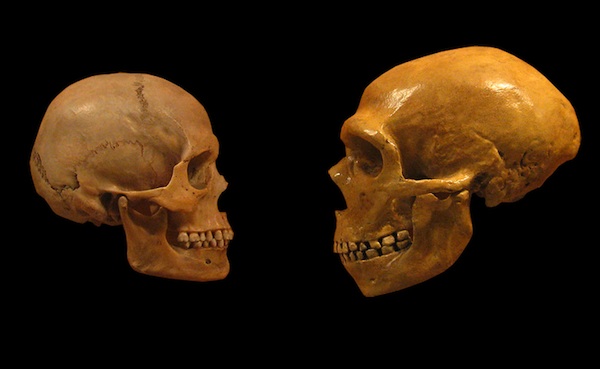
Neanderthal-Mammoth Study Latest Hint that Evidence for Neanderthals Interbreeding with Humans is Overstated

I confess to being somewhat of a contrarian when I think the conventional wisdom is being unwise. On the issue of the similarity between Neanderthals and humanity the conventional "wisdom" has become downright silly. And intense. There seems to be an avalanche of what I consider propaganda- because it is so poorly supported by evidence- that Neanderthals were "so much like us". This is combined with an unrelenting effort to spread the definition of "human" to include other hominids like Neanderthals. This campaign is propped up by numerous claims about their abilities which torture the evidence to support such a conclusion.


I also think the evidence for human (Homo Sapiens) - Neanderthal admixture is very much over-stated. I don't say it never happened but I think it rarely happened and when it did failed to produce successful lines of descent. Look, lions and tigers are very different kinds of big cats. Even moreso leopards and lions. Yet they have been known to produce offspring and the females of such unions are often fertile. Yet nature tends to punish such admixture as if she was trying to fix a mistake. The fertility rate is far lower and the genetic disease rate much higher than when they mate true to type.

One of the points made in the link in the previous paragraph is that there are other explanations besides interbreeding for why humans who lived in places where Neanderthals lived have similar gene mutations to Neanderthals. Now comes this article based from this study
 .

The article points out that both Mammoths and Neanderthals were supposed to be cold-weather-adapted versions of their kind. The article indicates that when scientists looked for mutations in genes which would make the creature better adapted to cold weather that both species had similar mutations! Obviously this is not because they were breeding with each other. It is because they shared the same environment and this produced genetic convergence. Why isn't it considered that convergence also produced the similarity in Neanderthals and humans who moved into Eurasia (and thus shared the same environment with them)? There is no sign of interbreeding in mtDNA from mothers or Y-DNA from fathers. The similar mutations between humans and neanderthals are in nuclear DNA, but there are other ways besides interbreeding to get these similarities.


Please "like" and "share".

Monday, March 25, 2019

Creation – Evolution Wars


 When they read the title “Creation-Evolution Wars” most readers will recognize at once just what I mean. At the same time, almost all Christians, creationist or not, accept that evolution on some level has occurred and is occurring. Even many young earth creationists think that the creatures on the ark rapidly diversified into a variety of forms after the flood. “Evolution” is not the opposite of Creationism. Naturalism, the idea that nature alone without any help from God can pull itself up by its own bootstraps, is the opposite of Creationism.
Naturalism is the belief or philosophy that nature is all that there is and all that there needs to be to explain what we see. Creationism is a subset of Theism as it applies to creation. It is the belief that the universe and everything in it is the product of a Creator who intervenes to work on His creation even after the initial creation event. Another position, Deism, is the belief God created the universe to wind up a certain way and did not intervene subsequent to the beginning.

I think naturalists have very cleverly shifted the argument from an indefensible position- the assertion that the natural universe is all that there is. The argument that the Cosmos and the richness of life on earth came to be without help from a creator is an extreme position that we almost certainly don’t have the means to really test, especially scientifically. To the extent we do I find it grossly implausible. But they have interposed “evolution” in front of their real position so thoroughly that most of us believe that the conflict is between creation and evolution. That’s mostly not true.

The conflict really ought to be called the “Creationism-Naturalism Wars” – ism vs. ism. One philosophy against another. Evolution is just the battleground in which much of the war is being fought. The Naturalists are adamantly insisting that natural forces alone can produce all the diversity of life we see and Creationists saying that Creation must have had help. It couldn’t do all this on its own. Naturalists cling to evolution not because it is the philosophical opposite of creationism, but because it’s the only answer they have to their actual opponent- Creationism.

As I will explain below, there is a great deal of overlap between creationism and some versions of evolution. Despite all the shouting, there are gray areas between creationism, “Intelligent Design” and Evolution. One could in fact be an “Evolutionary Creationist.” I don’t think that position matches the text of early Genesis well, but it is a philosophically possible position. Naturalists would oppose this position just as much as they oppose the idea that all species on earth were produced by God fashioning them out of clay. There are no gray areas between naturalism and creationism.
 In my book I make the case that Genesis chapter two is describing a very important smaller and more limited work of God within the much larger work of creation described in chapter one. That is, chapter two “zooms in” and describes in detail a special event which is necessarily only very briefly touched on in chapter one.
Chapter one is the story of the whole of creation from the beginning of time until the end of the age. Chapter two is telling the story of what happened in the Garden of Eden not too many thousands of years ago in a brief period. It is the story of a new work within creation which God intends to use to redeem and reconcile creation to Himself. Creation began as a place where the Word of God wasn’t. Therefore, it was originally subjected to futility. Creation was subjected to futility, but only in the hope that it could be raised out of futility through the illumination of God’s word which entered it and worked on it.
 That the account of Adam is a discrete event within the larger story of creation raises some interesting possibilities regarding the extent that what we might think of as “evolution” is responsible for life on earth. This is a very touchy subject for a lot of people on both sides of the issue, and I understand that what I have to say about the text in this chapter and those beyond it will probably make both sides unhappy at first. “Compromise” is seen as evil and anathema to both sides. I think compromise can be evil- when the truth is what is being compromised. I reject compromise at the expense of truth as much as anyone. But I also reject rigidity at the expense of truth. In this case, the truth is that the text of early Genesis takes a much more complicated and nuanced position than either of the extremes in this discussion advocate.
For example, the chapter two account is clearly describing a situation where both Adam and the animals of the garden are specially formed. This is very much like what we would consider the most direct form of “special creation”. But in the Christ-Centered model, this isn’t the whole creation. It’s a new work within a small portion of it. It is that mustard seed destined to grow and provide a home for many. It is a shadow of the remaking of the world which comes after some of us are born again through the sacrifice of Christ.
The text gives us much less detail as to how the original creation was fashioned. And what little information it does give could best be described as a synthesis of creation and evolution, as well as a spectrum of Divine intervention. This spectrum runs from a situation which sounds almost like deistic evolution for plants, to a middle ground in which the land and the waters obey God’s command to bring forth living creatures but only with God’s help, and from there all the way to humanity in which God may have used earth, but He did the work Himself.  
Earlier I talked about gray areas between evolution, creationism, and intelligent design. “Descent with modification” is a standard accepted definition of evolution. But it could also be a form of creationism or at least intelligent design, depending on how the "modifications" occur. For example, farmers breed animals for certain traits and get them through descent with modification. They select far more powerfully for desired traits than nature does. So that fits this definition of evolution, but surely it is intelligent design as well.
Let’s have a thought experiment: Suppose instead of farmers who went around selecting for traits, God Himself did so. If a certain group got a rare mutation that would produce a benefit if paired with another rare mutation which existed only in a second isolated group, then He would know it and be able to put those two populations together so that they would have the suite of mutations that, when combined with yet another rare mutation four generations from then, would result in a new function.
In this scenario the Intelligent Designer is using Divine knowledge to leverage natural processes to produce something new. I would say that is evolution (descent through modification), intelligent design (intent drives the changes not natural selection) and “soft-touch” creationism (He intervened in the natural world to produce outcomes even if He never touched the genomes directly, He merely guided natural events in a way that nature herself would not at anything like the same rate).
Now suppose that instead of taking the role of a selective breeder (with perfect knowledge) only, He also assumed the role of Genetic Engineer. That is, instead of strictly waiting for Nature to come up with mutations which could be combined to create new function, He did just what our genetic engineers do. He made cuts and inserts in genetic code. Maybe nature alone would never get a particular protein to fold just right by waiting for chance to make the proper mutation. Maybe the species would die out before the right changes happened along to allow them to become something else. So God inserted a gene which would, just as our scientists do now. When our scientists make mice which glow because jellyfish genes have been inserted in them, and this population breeds, is this “descent with modification”? It is, and thus meets a generally accepted definition of “evolution”, but the modification did not come wholly by "natural" descent. It is doubtless intelligent design and special creation, and by this definition “evolution” as well.
That said, such a situation could still involve natural descent, but that would not be where the key modification would come from. Take the gap between a fish and an amphibian. What if over the course of thirty or forty generations God acted to put just enough changes in each generation so that they would still be able to be birthed and bred by natural means, but each generation would also be further toward the amphibian end of things? This so that even though no amphibian was created out of thin air, or clay, one still had a very different creature though only forty generations removed from the fish. That result would be due to “genetic engineering” moving things a bit further along each generation. That is “descent with modification” but the modification that matters was via genetic engineering. Is that evolution, special creation and intelligent design all rolled up into one? So long as you are not a naturalist, it is all three rolled up into one. Naturalism can’t accept the idea that the changes came from anything but chance acting on the environment.

Now I have used the analogy of God acting as a “Genetic Engineer” but it is not necessary to assume that He required any lab coats or test tubes to pull this off. He can turn stones into children of Abraham (Luke 3:8)! Ultimately, we know that at the quantum level the universe does not behave mechanistically. Information coming from the realm beyond need not be blaring on AM radio waves. If one has sufficient knowledge and ability, they could send information into this world which would seem to us to be a “lucky break”. A molecule could bend this way instead of that, resulting in an improbably change which would otherwise take ages. Information could in principle seep into our world at a quantum level and we could not distinguish it from chance. At least not with our current state of technology.

There is biblical precedent for this line of thought in the 19th chapter of 1st Kings.
11Then the LORD said, “Go out and stand on the mountain before the LORD. Behold, the LORD is about to pass by.” And a great and mighty wind tore into the mountains and shattered the rocks before the LORD, but the LORD was not in the wind. After the wind there was an earthquake, but the LORD was not in the earthquake. 12After the earthquake there was a fire, but the LORD was not in the fire. And after the fire came a still, small voice. 13
And of course there is Proverbs 16:33 "The lot is cast into the lap; but the whole disposing thereof is of the LORD." Even outcomes which seem like chance are really determined by Divine Action.

Science might be able to come along later and detect the past presence of the wind which shattered the rocks, the earthquake which shook the earth, and the fire which burned it, but science would have no way of gleaning the the information from the “still, small voice” by which God spoke. Science can only say it was an unlikely coincidence that high winds, an earthquake, and a fire struck the same locality contiguously, but there was doubtless a natural cause for all three.
 Is there really any scientific evidence that known evolutionary processes can operate at the rate and scale necessary to explain all of the "modification" of life on earth through its history? Another way to ask it would be like this, suppose there were a billion earth-like planets and a single celled organism was placed on each. How many of them, using only known biological processes without any intelligent intervention, would have a biotic phase which looks anything like the history of life on earth?  I think the number would be "zero". Someone else might think the answer would be in the thousands or even millions, but none of us have done the experiment or anything like it to say for sure. Therefore, neither side has a scientific basis for saying either way, though one might have naturalistic assumptions on the question. It is a pity that few people can even recognize there is a difference between the philosophy of naturalism and the process of evolution.
I don’t think “natural selection” or any of the natural means we have discovered thus far could have, on its own, produced the vast diversity we see today or in the fossil record. I think nature had help. And I think some of this arguing we are doing over it is because we are talking past one another on terms.
If we get better at figuring out how fast these processes can really work to produce great change and what if any limits there might be, I can see a situation in biology arising which is very similar to that which as already occurred in the realm of Astrophysics. Many years ago, scientists thought that the universe was eternal. Then they discovered that it is likely that it started with a “big bang” (it had a beginning). Then it was determined that the fundamental forces which determine the structure of this universe had to fall within very, very, very, very narrow parameters for the universe to be able to support life as we know it and perhaps even life as we can conceive it. If any of those parameters varied for a whole host of fundamental measures, then life could not exist. It was like the universe was designed to be able to host life. 
This was called the “Anthropic Principle” and it drove “naturalists” to distraction. How could they avoid the conclusion that the universe had a Designer when its fundamental forces had to be so precisely balanced for us to be here? It was like we were meant to be here. Chance failed as an explanation because we aren’t that lucky. It would be like winning a billion lotteries and for the last thousand of them you didn’t even buy a ticket! Ironically, some Christians are still opposed to the idea of a “big bang” because they don’t see how it is really an overwhelming problem for the naturalist viewpoint. The universe had a beginning, just like it says in the very first verse of The Book. 
The escape hatch for the naturalists has been the “multiverse” theory. This idea says that this universe is only one of an infinite or near-infinite number of universes which have all come about by chance. We were not lucky, rather if there is a vast number of universes then by chance one of them could turn out to be able to support life, and eventually, again by chance, evolve beings able to ask questions about where we come from. Does this sound scientific to you? It isn’t in the least. It shouldn’t even be called a “theory” because a theory is something which has been confirmed in some way by scientific experiment or observation. It really isn’t even a decent hypothesis, since a hypothesis is supposed to be able to be tested scientifically in some way and we can’t test for the existence of other universes. 
I call it what it is, a desperate escape hatch for those who want to deny the existence of a Creator. It’s an act of rebellious faith that there is no one to whom they are accountable. Assuming we have an infinite number of universes when our known set is “one” is surely a gross abuse of probability theory. Even if there are vast numbers of universes, it still is not proof that there is no God since He could have created them all and maybe all of them support intelligent life within them. 
Even so, I have seen atheists very aggressively and brazenly insist that theists are the ones “without evidence” for their position. I have seen them, in a powerful example of psychological projection, accuse theists of ignorance while they pose as the ones with “knowledge”. But I ask you, who in this case has the worst kind of ignorance in the cosmos- willful ignorance? It is the worst kind because the intelligence and reason of the offender is focused on maintaining ignorance rather than knowing truth. It is the worst kind because it can’t be cured with an application of knowledge. That’s because its not a knowledge problem, it’s a heart problem. Repentance, not more information, is the only cure for such belligerent willful ignorance. 
I mention all that about astrophysics because it is possible we are in a similar position with “evolutionary science” that we were with astrophysics some decades ago. With a small amount of knowledge it looks like chance could explain all of the changes we see, but as we learn more we may discover that like the cosmos itself, earth’s biota will appear to have gotten very, very, very, very “lucky” to ever wind up with creatures like us or many other of the living things in the vast array of life on this planet. We may find that the earth and chance can produce some variation in living things, but not anywhere near the scale and scope necessary to account for the richness of life on this planet. As with the universe, none of that will “prove” that God guided nature but I predict that if we ever get that far naturalists will have to resort to the types of evasions we see with astrophysics in order to deny the implications that nature would be screaming at us- without Him nothing that is would be.

*******
PS- I also have a book. It is more theology than science and it's work to get through but if you want to do the work, the glorious truth about Early Genesis is there for the having...


Please "like" and "share".