Monday, February 24, 2020

Pattern of Life Defies Evolutionary Expectations

According to this report a study has concluded that life has a strange pattern. A new type of organism will appear and last a long time with very little diversity, and then when it reaches a version of its modern form, have a "flowering" where it bursts forth into a wide variety of forms. It seems this pattern makes a mess of molecular clocks.

To quote the article:
Budd and Mann show that the ancestral forms of modern groups are typically rather few in number, and once they give rise to the modern group, they can be expected to quickly go extinct. The modern group, conversely, tends to diversify very quickly and thus swamp out the ancestral forms. Thus, rather surprisingly, living organisms capture a great percentage of all the diversity there has ever been.
The only exceptions to these patterns are caused by the "mass extinctions," of which there have been at least five throughout history, which can massively delay the origin of the modern group, and thus extend the longevity and the diversity of the ancestral forms, called "stem groups." A good example of this is the enormous diversity of the dinosaurs, which properly considered are stem-group birds. The meteorite impact at the end of the Cretaceous some 66 million years ago killed off nearly all of them, apart from a tiny group that survived and flourished to give rise to the more than 10 000 species of living birds.
Noting how early bird-like forms appear in the fossil record, I had speculated in Early Genesis, the Revealed Cosmology that Dinosaurs were "meant" to be birds all along. At any rate, this is yet another example of a pattern of life which defies naturalistic expectations but fits well with the idea that creation was working toward an intended end-goal. With help.
******************

Get the book.


Please "like" and "share".


New Study Opens Door to Mankind Being Much Younger (No YEC, Not THAT Much Younger)


A recent study now proposes that Sub-Saharan Africans also had introgression from a non-Sapiens source. They don't have a species to match with the alleged introgression, but the contribution in some extant African groups would reach double-digits! I think these statistical models have gotten out of hand and are connecting dots that don't really connect, but let's say they are right. Wouldn't this open the door to the distinct possibility that much of what we now think of as human genetic diversity is in fact from limited introgression?

So instead of the genetic evidence suggesting that our kind has been around 200K years or more there could have been a distinct low-diversity Homo Sapiens core group around for a far shorter time period. Maybe so distinct that there was only a short time at the start where they even interbred with the hominin zoo even a little bit. So Sub-Saharan Africans would not be older than the rest of humanity. They would just look older because a more heterogeneous genome has a higher mutation rate (W. Amos) and some introgression has not been labeled as such- we think its diversity picked up over a long period of time when in fact it was introgression of other-hominin genes that were just a little more diverse than ours.

No matter how they got here, "True" Homo Sapiens could have been a distinct population only as recently as the proposed introgression- 55-60K ago. Since the term "human" has been expropriated by naturalists to mean any hominin, I propose the term "Adamics" for this group. They started in the mid-east and NE Africa, and that's why the most "diversity" and "introgression" shows up in populations farthest from that area- in three different directions. I note that either this idea, or the ideas of Dr. William Amos cited above could produce a false "appearance of age" in a Mankind that started as a group rather than as a single couple. Calculations of "Most Recent Common Ancestor" don't really apply to any type of living thing which started as a population for reasons described here. 

*******

This article is not directly related to the Christ-centered model for early Genesis as described in my book. Still, I ask you to get the book...

Get the book.


Please "like" and "share".


Tuesday, February 18, 2020

Gently Correcting William Lane Craig on Representative Adam

The recent (Dec of 2019) Biologos podcast on Adam presented an overly-negative view of "Representative Adam". They had the esteemed William Lane Craig critique Representative Adam, and here I sort of critique his critique. How do you dispute with a genius? Very gently! 

Saturday, February 15, 2020

Ichthyosaur, Ichthyosaur, I've Heard Such Talk as That Before

I want to make a note of this report on a study of Ichthyosaurs. The article leads with a quote that sounds familiar to me in reference to many other groups.
Dr Ben Moon, who led the research, published in the journal Communications Biology, said: "Ichthyosaurs are a fascinating group of animals to work on because they evolved so many adaptations for living in water very quickly: a fish-like body and tail fin, giving birth to live young rather than laying eggs, and lots of different feeding styles.
"Because of this we expected to see a rapid evolution early after ichthyosaurs first appeared, but we were staggered by just how big this early burst was and how relatively short it was."
It was the sort of statement I had heard many times before, both for smaller clades of creatures at various points in earth's history and for the origin and diversification of aquatic life. For example the Cambrian Explosion (which revisionists are continually striving to minimize and re-interpret to make it seem less dramatic) and the later Ordovician. There is a repeating pattern. Basically there is a low-grade "steady state" evolution which just seems to tinker with existing types within a limited range, and then something else. Something which produces vast amounts of change in lengths of time which, though they may be long compared to humanity, are extraordinarily short in terms of an evolutionary time scale.

Something weird is going on and being co-flated with something ordinary, all of it being lumped together under "evolution". Since those who ought to won't differentiate these results with separate process names, I will. As a peace-offering, I will even use their language to do so: I will call the ordinary change that continues "evolution", and I will call the astounding large-scale and rapid change which comes and goes away "macro-evolution".

The article notes that after their big burst of diversification Ichthyosaurs stayed diverse for quite a while, but ceased the rapid macro-evolution noted earlier. Then there was a mass extinction event which  only one line of the Ichthyosaurs survived. This surviving lineage went on for an extended period, but never diversified much. Sure there were a number of different species, but they stayed close in form to the one original surviving line. This despite being in all sorts of circumstances similar to the original diversification, such as times of mass extinctions. Why did this lineage quit macro-evolving?

This is something I have noted before. It is like "evolution", or at least "macro-evolution" plays with a group for a while, and then fixes its attention elsewhere. In the big picture I noticed that reptiles pretty much stopped macro-evolving while the line leading to mammals seems to have continued to do so. Why did one group (the one which includes us and the animals most connected to our lives) continue to develop while the other forms lock in place for vast eons of time? "Macro-evolution" is not behaving so much as a universal natural force, but as a Designer with intent. Once one part of the job is done, once the playing-around with certain concepts is fully explored, attention is directed elsewhere.

Perhaps the reader is a bit confused as to what I am getting at with all this, so I will spell it out. I don't think the "macro-evolution" part is just nature. I have described elsewhere the gray areas between creation and evolution. There are some things that can occur which fit the standard definition of evolution, but are nevertheless special creation. The two blend into one event once one sees past the naturalist paradigm.

*******

This article is not directly related to the Christ-centered model for early Genesis as described in my book. Still, I ask you to get the book...

Get the book.


Please "like" and "share".

Friday, January 31, 2020

Bats and Dolphins Share Genomic Regions

Bats and dolphins both use echo-location, albeit one in the water and the other in the air. Still, not many other creatures share such a trait, and scientists wondered, out of the hundreds of special genes required to produce this special feature, how many of them were similar in both types of animals?

In a way it was a crazy question to ask if macro-evolution is true. After all, they are not closely related. They are about as far apart as they can be and still be in the same class of organism. As the article concedes, these two groups would have evolved echo-location independently of one another, so what would the odds be if they used more than a few of the same genes to do it?

The vast number of genome regions which have to change together to successfully acquire the ability to echo-locate is problem enough for the macro-evolutionary hypothesis. The results of their study astounded them and made the macro-evolutionary hypothesis even harder for thinking people to accept. It turns out almost 200 genomic regions were virtually identical in the two groups of organisms. "We had expected to find identical changes in maybe a dozen or so genes but to see nearly 200 is incredible," explains Dr Joe Parker, from Queen Mary's School of Biological and Chemical Sciences.

They chalk it all up to the power of evolution of course, because they have an "evolution of the gaps" bias. Whenever they see something that "astounded" them, as this did, they chalk it up to the power of evolution via some undefined pathway. They called this an example of "evolutionary convergence". Honestly though, a finding like this gives a lot more support for the Intelligent Design Theory. That is, two vastly dissimilar organisms can share the same genes because they had a common Designer, who used a similar idea for a similar function in the same genes of the two groups. Under that scenario, it is not necessary for the two groups to have had a common ancestor in order to wind up with the same genes.

Evolutionary convergence used to mean animals which were not related had a similar form due to performing similar functions. The classic example is sharks and dolphins. Their physical forms were shaped in a similar way by a common function. Evolutionists are trying to shoe-horn this idea into the exciting findings they are making in genetics. But it doesn't fit. There is no reason to expect that the same genes would be adapted in both species for such a novel function as echo-location. It is basically describing "conservation" of individual genes that were not inherited from a common ancestor, which of course goes against the very definition of conserved genes.

Example: If I build a grandfather clock from metal shards, and a man in China does the same, the faces of our clocks may look alike, but there is no reason to expect that a specific part from my clock would even exist, much less fit, in his clock. Evolution shapes the end result, but the means to get to that result are supposed to be random, chance changes being selected for or against by the environment. When the means are the same, it is a mark against the hypothesis, or would be if they were not trying to rig the terms of the debate so that no matter what the evidence shows, "evolution did it". That's an "evolution of the gaps."

It is just a way of saying that whatever happened, evolution did it. If sharks and dolphins look similar but have different genes to breath, why evolution produced the differences, while if dolphins and bats use the same genes for echo-location, why, evolution did that to. It makes the idea impossible to falsify via the scientific method. Which of course, means that it is no longer science at all.

*******

This article is not directly related to the Christ-centered model for early Genesis as described in my book. Still, I ask you to get the book...

Get the book.


Please "like" and "share".

Sunday, January 26, 2020

Between the Fall and the Flood

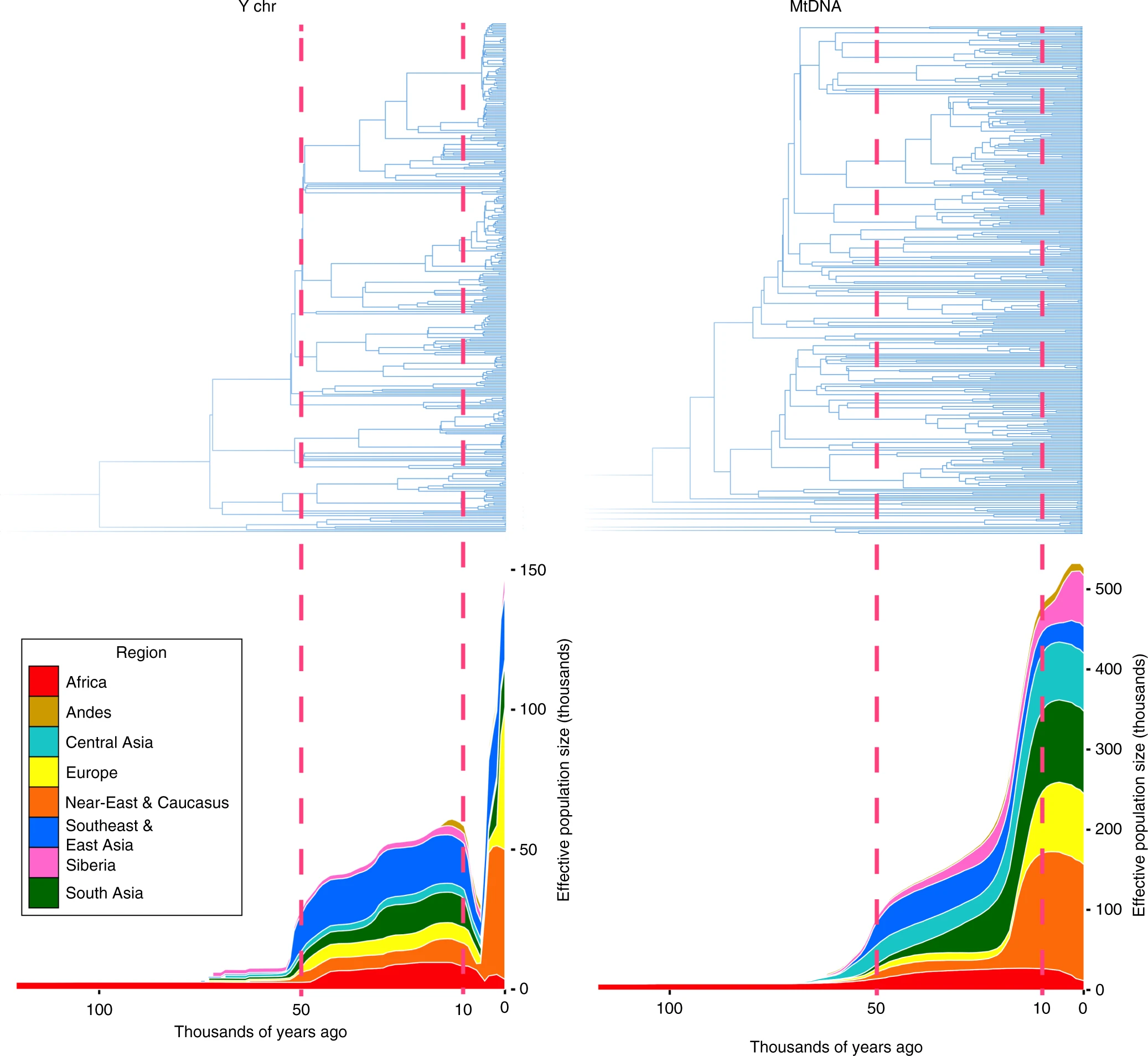
The evidence shows a massive loss in male diversity around the world starting around 10,000 years ago until around 5,000 years ago when diversity recovers. Click for larger view.
"11 The earth also was corrupt before God, and the earth was filled with violence.
12 And God looked upon the earth, and, behold, it was corrupt; for all flesh had corrupted his way upon the earth.
13 And God said unto Noah, The end of all flesh is come before me; for the earth is filled with violence through them; and, behold, I will destroy them with the earth." - Genesis chapter six
The Christ-Centered model for early Genesis is a different take about what the text is saying from the traditional view that the church inherited from Judaism. Adam doesn't have his traditional, but non-biblical, role of "sole male progenitor of the human race". Instead he has his New Testament role of "figure of Christ" (Rom. 5:14). He is only the first man in the sense that Christ is the second, or last man (1st Cor. 15). That is, in God's plan to reconcile humanity to Himself. There was a population of "Adam", IOW humans, outside the garden and the LORD God formed Adam and Eve inside it. Some of you reading this may think that you know of other scriptures which contradict what I have written above. I once thought I did too, but I was wrong about what I thought they meant.

Jesus said in John 5:46 that Moses was talking about Him. If we don't see the text as pointing to Him, then we don't have the view of the text that He has. The Christ-centered view of the text does that, the traditional, non-New Testament, view of Adam does not.

The Christ-centered model has Adam introduced up to 12,500 years ago (but perhaps somewhat less, the key is that Ussher's accounting gives dates which are too young) along with "helper" animals and plants which gave mankind a "leg-up" in shifting from hunter-gatherers to agricultural and animal pastoral lifestyles. Ground zero for plant and animal domestication fits very well with the Christ-centered model for Adam.

All of that brings me to the graph pictured above from this report in "Nature".  Astoundingly, the evidence suggests that there was a massive plunge in Y-haplogroup diversity, passed from fathers to sons, starting about eleven thousand years ago but accelerating steeply until perhaps five to seven thousand years ago, and then a radical recovery. Many of the surviving Y-haplogroups saw a burst in diversity from seven to five thousand years ago, indicating that the conditions which produced the plunge in diversity were mitigated. The diversity of females, as shown by mtDNA, did not take a corresponding plunge. This would be what the data looked like if females outnumbered men, at least in terms of genetic diversity, seventeen to one! It is an astounding period as this happened globally, albeit with a slight lag in Africa.

The most reasonable explanation for the vast drop in male diversity suggested by the paper is that clans of related males wiped out competitors and took their women. In other words, a surge of violence. Though I don't give exact dates for the fall, a point at which everyone's eyes are opened to their own sinfulness and innocence is lost, the range fits extremely well with the date range shown in the graph above where diversity first starts taking a dip (due presumably to an increase in violence). My proposed date range for the flood of Noah (which did a reset- not on all life on earth but only the more limited set of living things formed in chapter two including the line of Adam) fits very well with the point at which diversity begins to increase again- from five to seven thousand years ago.

The paper speculates as to why diversity decreased and why it started up again once city-states came along. I don't dispute those claims. I just think they go hand-in-hand with the scriptural account. People became aware of their own sinfulness, and there will always be those who, when faced with the reality of their own nature, embrace it and go even worse. It is true that with agriculture and herds and flocks there was more to fight over, but Adam had a role in that too. And despite their attempts to draw some comparisons to other much smaller events, this period seems unparalleled in scale and degree.

Look, the world today is full of those who "deny the truth in unrighteousness". Remarkable correlations such as the ones shown in this piece won't move them, because they will simply deny the evidence means anything. Deny. Deny. Deny. That's what they do. And we shouldn't be surprised by this, but we should understand the reason for it. It's not that the evidence is lacking, but that the conditions of their hearts to receive it are lacking. They are unwilling to receive for whatever reason, evidence which points to the truth of God and His Word. Someone who is able to receive can look at the same evidence, as I have, and be astounded at how strongly the signal matches up with the account in scripture once rightly understood. In the same time frame that scripture reports that the earth was full of violence, scientists find strong evidence of violence to a degree which has not been equaled globally before or since. It ends about the time of the flood which scripture says God used to wipe out those who were leading the earth astray. The unbelieving heart is hard to it all, and well able to dismiss it all with the waive of a hand. We should pray that their eyes become opened so that they may see what is, without letting it get us down. Rather, let us wonder and glory at the truth of His Word displayed in our natural world.

Get the book.


Please "like" and "share".


Wednesday, January 22, 2020

The Christ-Centered Model for Early Genesis- Just the Narrative

Because you should not have to wade through the evidence in a four-hundred page book to hear the narrative.