Friday, April 24, 2020

On False Definitions of the Agnostic and Atheist Positions

UPDATE: There used to be a diagram here from an atheist group "ActOK.org". Rather than engage on my arguments they cut off my access to the diagram. That is their right I suppose, but it indicates they lack a good argument for the points I make. But what isn't OK is that "ActOK" also hijacked this page so that people who come here are re-directed to their page, and in my case a message saying "account suspended". A group called "ActOK" yet they act like that! Truly, those who reject the LORD reject reason as well!


Balderdash- why this diagram is misleading, though it pretends to clarify

The definition of atheism which atheists prefer, and have been able to finagle into the dictionaries (yes, they got it changed, check out Webster's 1828 edition on it) is....
Atheism - a lack of belief in God or gods.
I have found that almost all persons who claim to be atheists quickly move to an agnostic position in actual discourse. The latter position is at least somewhat intellectually defensible, and it is part of a little rhetorical dance that they do to, in their own minds, put the "burden of proof" on theists. But its not the position that goes with the label. They have to jump back and forth between two conflicting labels to pull off this rhetorical trick. They want to be in two mutually contradictory states at once in order to maintain the illusion. It is really hard to have honest and open dialogue with people who begin by muddying the waters like this. I have found they don't like to engage unless they get to define all the terms of the discussion so that they have a favored position before the dialogue even begins in earnest.

The actual atheist position, not the agnostic position which most atheists I have met shift to when confronted with the irrationality of their true position, doesn't require all knowledge but it does require knowledge which is far beyond human capacity to know. One would have to know to a reasonable degree of certainty for example, that all claims by all persons of direct encounters with God or His angles are false either through deceit or mistake. This would include the claims of the New Testament. One would have to know to a reasonable degree of certainty that God isn't to be found anywhere not only in the vastness of this universe but in whatever realm lies beyond it.

That's not "all knowing" but it does arrogate  the proponent to a level of knowledge which is wildly unbelievable. That's just part of why the position is foolish. I know the definition above is that which atheists prefer, but it is, like their real position, dishonest in the extreme. It deliberately confuses atheism with agnosticism. It is part of this ever-shifting vibration between two states at once that they wish to do in order to make their position appear like the rational one. 

Here is the problem with the definition of atheist that they want to use: Someone might have a "lack of belief in God or gods" for two reasons. One is that they don't know if God or gods exist. That's an agnostic. Their definition for "atheist" also applies to agnostics, confusing the categories. The agnostic only knows that they don't know. Maybe someone else knows but they don't. They are only claiming a lack of knowledge for themselves, and unless they are claiming that the true evidence is unknowable, they do not possess either a negative or a positive conclusion on the question. The atheist goes beyond simply not knowing. The reason they "lack belief in God or gods" is because they believe they don't exist.. They have an opinion on the question. They have come to a conclusion. They think they know the answer, and their answer is in the negative. There is no rational evidence for the existence of God.

These days it is like trying to nail jello to a wall getting atheists to define their position in a way that isn't also applicable to agnosticism. This is the dishonesty that I and others complain about. Why do we have such difficulties in our dialogue? Many reasons, but one of the starting points is we can't even seem to get a straight answer out of them as to what their position entails.

I have heard them reply with something like the following: "there's a separate label because they answer two different questions. Atheism/theism is about what you believe. Gnosticism/agnosticism is about what you know, or claim to know (or not know.)" That's the basis for the diagram at the top of this article. That such a diagram has even been concocted demonstrates the extreme lengths they will go to in order to make separate and unconnected categories of these things so that they may hop back and forth as needed to avoid being pinned down.

Perhaps you have spotted their sleight of hand? The chart is constructed so as to justify their definition of atheist. It does this by separating what you "believe" with "what you think you know" as separate categories rather than points along a spectrum. But given naturalist suppositions, how are these terms different in anything other than as points along the same spectrum? Only in a theistic context where "believe" means to "have faith in, trust" are they different things in kind, not just quantity. So then the Devil would be a "atheistic gnostic" in the sense that it knows that God exists but has no faith in Him. But under the definition in their chart, which uses the natural definition of "believe" for something that you think is true but with a lower level of confidence than what you know, the Devil would be a theistic gnostic. It both believes and knows that God is. The Apostle Paul would be in this same category with the Devil, which might give you some indication of how useless the table is except as a rhetorical trick to keep atheism superficially defensible and attempt to keep the "burden of proof" on the theist side!

That's more intellectual chaos because in naturalistic terms (excluding the definition of "believe" that implies faith and trust in a religious sense) believing and knowing are in kind one and the same thing. They simply express varying levels of confidence.  If there are no gods, nothing beyond nature, then all our truth is held provisionally with varying confidence levels which never reach 100%. In fact "knowing" is used loosely in the natural sciences. It is just something we believe very strongly is true. Atheists should not hop back and forth between a metaphysical definition of "know" and the more provisional version of knowing drawn from naturalism. The defense of this view of atheism and agnosticism leans on a metaphysical/religious view of knowing when they constantly deride the idea of the metaphysical and religion! I cry foul.

All of this hopping back and forth and twisting of words serves a purpose. Part of that purpose is so they can pretend that the "burden of proof" is on "the person making the positive claim". By pretending "believing" and "knowing" are different categories (in the natural sense) rather than a spectrum along a single category, naturalists can pretend that "atheists" and "agnostics" are also different categories rather than a spectrum along a single category. Everything must be fudged and confused and obfuscated lest the truth be shown too clearly: Both theists and atheists are making positive claims. They both take positions on the evidence. In the case of the theist, the evidence favors the existence of God, in the case of the atheist, the positive claim is that it is lacking (or that they are not rational, since if the evidence existed, it would be irrational of them not to accept it). The only position on the spectrum which truly doesn't make a positive claim is the agnostic (unless they are claiming that no one can know in which case they too are making a positive claim).

I have heard them say things like, "To me, the position that something doesn't exist seems like the most logical position to start with if nothing relevant is known."

In this case, something relevant is known. There is an effect, we are here. The universe exists. Therefore it isn't rational to assume "nothing" when you see an effect. The rational position is to assume a cause, and we debate over what that cause is. Those who contend this cause is unknown are making a positive claim, and those who contend that God created the universe are making a positive claim. Evidence on such a great question may be difficult, but no one side has the "burden of proof". They are both making positive claims about the evidence and they both have an equal burden to support their claims. The only one who doesn't is the one who makes no claim about the sufficiency of the evidence, that is, the true agnostic who just says that they personally don't know (which is different from the positive claim that no one knows, that the answer is unknown to any).

Speaking of evidence that the scriptures are inspired by the one true God, this conclusion is a natural consequence of the Christ-centered model of early Genesis described in my book. Christ made an astounding claim, He said that Moses, who lived over a thousand years before Christ, wrote about Him! Obviously this claim could not be true unless Christ was God. Once you understand the Christ-centered model, it becomes clear that not only is Christ's claim true, but seeing the material through the lens of Christ also makes the narrative much less contentious with evidence from the natural sciences and history than the traditional view of the material does. If they demand evidence, we have it. Early Genesis is about the work and person of Christ.

Get the book.


Please "like" and "share".


Monday, April 13, 2020

I Remember When Fundamentalists Were Mocked for This...Monkeys Raft Atlantic!

I saw this article from Science Daily talking about a find of fossilized monkey teeth. The standard view of things has a problem because it is believed based on genetic and fossil evidence that old world monkeys and new world monkeys evolved from a common population in Africa with the split happening perhaps 34 million years ago. Problem: there was already an Atlantic Ocean back then. Almost as big as the one here now.

The answer to this mystery is proposed in the article in the link above...
The monkeys are believed to have made the more than 900-mile trip on floating rafts of vegetation that broke off from coastlines, possibly during a storm.
"This is a completely unique discovery," said Erik Seiffert, the study's lead author and Professor of Clinical Integrative Anatomical Sciences at Keck School of Medicine of USC. "It shows that in addition to the New World monkeys and a group of rodents known as caviomorphs -- there is this third lineage of mammals that somehow made this very improbable transatlantic journey to get from Africa to South America."
I can remember certain creationists proposing similar ideas about the dispersal of animals from the ark of Noah to far-flung places. They were ridiculed relentlessly. Not that I have a dog in that fight because the bible does not really teach that all land animals were on Noah's ark.  Still, the idea that this proposal for monkey dispersal could be tossed out there so easily brings to mind a maxim for internet discussion: Remember, it's only ridiculous when creationists propose it! 

The "Wallace Line" is a thing because animals can't even cross the straight between certain Indonesian Islands. Suggesting that monkeys and other things made repeated journey's over 900 miles of Atlantic ocean in the broiling sun with no fresh water on a mat of vegetation is preposterous. It is just as reasonable to believe that millions of years ago angels or aliens carried populations of monkeys from Africa to South America as part of some master-plan to guide life on this planet. This is just another example of how what we see in nature is not reasonably explained by what we see in nature!

***********

The book is really about the work of Christ in Genesis and not so much the "Creation-Evolution" debate which I believe the Christ-Centered model soars past. But still, I encourage you to buy the book.


Get the book.


Please "like" and "share".


Tuesday, April 7, 2020

Genesis Chapter Five Genealogy and the Strange Number Pattern

The problem: Skeptics use the patterns of years in the genealogies to dismiss the idea that these are actual events or accurate times. They imply that whoever wrote early Genesis manufactured the genealogies and their numbers to make some esoteric point, though I've never heard any reasonable explanations as to what that point might have been. One fellow I've been conversing with explained it like this when referring to the Genesis chapter five genealogy....
 Is it coincidence, that we have 29 numbers out 30 in the genealogy (exception = Methuselah, who died the year before the flood) which are multiples of 5 or seven plus a multiple of 5?
This means that all of the numbers end in 0,2,5,or 7, and none ends in 1,3,4,6,8 or 9. If the numbers were simply random ages, this would only occur with a probability of (0.4)^29 = 3 *10^-12;
i.e once in every three trillion genealogies.
He's referring to the numbers in the Masoretic text, but the Septuagint shows a similar pattern. With the exception of Methuselah the text shows a pattern which is extremely unlikely to occur by chance. Now when apologists present similar calculations to skeptics regarding the improbability of say, biogenesis via naturalistic means, or any one man fulfilling all of the prophecies which Christ did, I've noticed that they deny, dismiss, and find all sorts of empty excuses why our calculations mean nothing at all.

We want to be of more noble of spirit than those who try hard to not see truth, because our relationship to truth should be different once we have been saved. Our witness is that both the Living Word of God, who is Christ in whom we believe, and the written word, the Scriptures which speak of Him and reflect His glory, are true. I would not say that I am a "fundamentalist" per se, because that term has become hi-jacked by people who have different sins to repent of than the ones I have. Such as trying to make scripture fit to certain cultural norms as well as a very forced over-simplification in method of interpretation that scripture itself does not support. Call me a "neo-fundamentalist" if you like. My point is, just because those who are without faith dismiss and deny our valid numerical objections as, for example, "argument from incredulity" does not mean that we should stoop to that level. Are we not redeemed? Do we not live in the Truth, which is a Person? The fact is, this pattern of numbers is highly unusual. They don't appear as "random ages".

I would also say to those who put great stock in what has become known as "Critical Biblical Scholarship" that they need not adopt the naturalist premises which have infected today's seminaries in order to do "Critical Scholarship". I offer what is below as a modest example of how one can do a bit of "Critical Biblical Scholarship" without the dreadful premise that scripture isn't what Christ said that it is.

I want to make it clear that I am not saying that these numbers can be used to calculate times per the method of Bishop Ussher. It is my position that the narrative part of the text shows that Ussher's methods will derive dates that are too young. I don't want to get distracted by that now, but I don't want people who can't accept Ussher's dating to "turn off their ability to hear" what I am about to write because they can't accept some other assumptions about the text. Some people will have that same reaction to the idea that there were people who lived over five hundred years. That too is a separate issue which I discuss in my book. I ask that you suspend disbelief on those points, if you have any, in order to evaluate my hypothesis regarding the pattern of years in this genealogy.

First, I am adherent of a modified version of the Tablet Theory. It must be modified because critics have raised a couple of valid (and some invalid IMHO) critiques of the original theory. The modifications address those issues, though so far as I know those who believe they are experts have not evaluated the modified version (and thus I conclude they have no reasonable grounds to dismiss it). Moses didn't write early Genesis from a blank scroll. Rather, he had tablets passed down from his ancestors like Abraham, which told their stories. These accounts were ancient even in Abraham's day, though some portions, like the table of nations and the genealogies, were always understood to be a work in progress which were to be updated from time to time. The tablets were not in Hebrew, which has a later origin than the earliest accounts in Genesis. Moses had to translate them, perhaps from a language that most of his countrymen could no longer understand.

Is there a reasonable explanation why all of the dates would be in multiples of five, or multiples of five plus seven (please don't get hung up on the exception of Methusualah)? There is. Let's start with some things that we know.

1. The ancient Babylonians (with whom the ancestors of the Hebrews interacted strongly) like many other ancient cultures, had twelve thirty-day months in their year. So they had 360-day years. (Edit, or maybe not. At least at first. The Vedics started with a 360 day year which had 12 months of 30 days even as early as 7,000 B.C. It seems like the Babylonians emphasized lunar cycles, which would result in a 354 day lunar year. They added months every so often similar to what is described below to re-align the cycles of the sun and moon. Before their system was formalized, the number of days in the added months seems to have not been set, but was made what was needed to re-align the observations).

2. A lunar month varies in time by a few hours, but averages out to be 29.53 days.

3. A lunar year then, with twelve lunar cycles, would be approximately 354 days in length, with a fraction of a day remaining. Later some cultures made the year consist of six months of 29 days each and six months of 30 days each in recognition of this fact. This is a 354 day "lunar year".

4. A solar year is 364.2422 days.

5. The Hebrews considered that both the Sun and the Moon were given to regulate times and seasons and years.

6. Ancient cultures experimented with all sorts of systems to reconcile these time measuring systems.

***** EDIT: I am such a dunce. I do my thinking backwards, making things harder than they have to be. Instead of reconciling the text and the observations with something I constructed from scratch, I should have first done decent historical research about what the ancients did. If I had, I would have found they got to the same place I did, though maybe not by the same route I used.

Clearly, I am not a good historical scholar. But I have still resolved this issue when no one else did simply because most of the ones who are really good at it are presently using their gifts to try and convince people that early Genesis isn't historical narrative in any real sense. That's their focus. They are outdoing one another devising ways to, in their own estimation, poke holes in the narrative. That is now a crowded niche and the low-hanging fruit there has long since been plucked. I am trying to find ways to reconcile the text to a real and literal historical narrative, like Christ and the apostles thought it was, even if that requires people to see that what the narrative is saying is somewhat different than what they thought it was saying. So in evolutionary terms I am "exploiting an under-used niche" which means I can survive even without being very good at it. Hopefully, in time some of those real scholars crowded into the naysayer niche will get tired of fighting for share in a over-exploited area and start grabbing all this low-hanging fruit I am enjoying in the area of confirming that the text has historicity, but outside the traditional understanding of it.

Reading what I wrote immediately below will give you a good idea of how natural counting times in groups of five and seven years would be to them generally. I have added a section below (after some more study) which describes more precisely how I think this system was formed, and why it would be very natural to count time in groups of five year blocks, with an occasional seven year block thrown in.
*********END EDIT***

So these six facts together point to some problems the ancients had in tracking time. The 360 day years were nice and even and roughly correct. They were also a good "middle ground" between a lunar year and a true solar year. But they needed adjustments because each actual solar year was 4.24 days longer. If you failed to adjust then soon your Winter months would drift over into Summer months and vice versa. It wouldn't take long. In just ten years you would be 42.4 days, over a month, behind in your calendar in order to catch up to where the earth was in actual solar years. Or see it vice-versa if you like. The point is, an adjustment had to be made from time to time to keep the normative year in line with the movement of earth and Sun.

In terms of lunar years the problem is worse, because they are approximately 354 days long. So if you wanted to reconcile lunar years to your 360 day calendar you had to make another adjustment. That is just one issue. Matching them up with the actual solar year requires finding another 4.24 days somewhere.

One way to solve the problem of reconciling your 360 day calendar with a roughly 354 day lunar calendar is to group the 360 day "years" in batches of five. Each year your 360-day calendar ran six days ahead of your lunar calendar. But five time six is thirty, which is close to the 29.53 average lunar cycle. So every five 360-day years the two calendars could be lined up again with a small adjustment.

Let's call five 360-day cycles of time a "quin", Latin for "five". At the end of the quin your lunar cycle would be back in synch with the 360 day calendar, though every other quin you might have to declare the synchronization month to have only 29 days to line it up more closely.

It is difficult to believe that none of those near eastern cultures, who watched the sky with great skill, failed to notice this synchronization and had a term for it. This hypothesis has predictive power in that I postulate that such a term existed and may be found in the historical record. Perhaps that term, which I am calling "quin" here, became a unit of measure for large amounts of time- like the lifespan of long-lived patriarchs. So when Moses got his records, they did not say "Noah lived 500 years..." but they said "Noah lived 100 quin" which he translated into the proper number of years because they no longer used that system of calculation. The unit would mean nothing to the children of Israel.

This still leaves the mystery of why an occasional "7" would be added to these numbers. The mystery could be resolved simply by continuing our same train of thought. The "quin" might be enough for reconciling the lunar calendar to the 360-day calendar, but another measure was needed in order to adjust it to the actual solar cycle. Each solar year, the 360-day year would fall 4.2422 days further behind. At what point would it fall a month behind? You guessed it. 7 X 4.2422 days  = 29.695 days. If every seven years they added a month into their calendar, it would "slow down" their 360-day calendar and give actual solar years a chance to "catch up", restoring the months to their proper seasons. I will call this unit of time a "septa", Greek for "seven".

Similar to the situation with the "quin" and the lunar calendar, you would occasionally have to adjust whether this once-every-seven-years added month had 29 or 30 days. Alternating evenly between 30 and 29 day months would add on average 29.5 days of "catching up" to where the Sun is in space, but what about that last approximately 0.2 days? Every seventh year your extra month would lose the difference between 29.5 and the actual number of "extra" solar days in seven years, 29.695 days as shown above. An easy rough solution would be to start with a thirty day month and then track your septas by fives. Every thirty-five years (fifth septa) you start over and have another 30-day month instead of alternating. So instead of 30-29-30-29-30 and then back to 29 you would start the sequence over and have 30-29-30-29-30 and then repeat the sequence starting with another 30. This would get you to 29.6 days, which is very close to the actual value, and we are using a span of years which is also divisible by five (35).

If you wanted to get even closer to the actual solar year, in addition to having back-to-back 30 day bonus months every thirty-five years (fifth septa) you would also add a bonus day on the bonus month of the seventh septa, or every 49 years, giving you a period of three septas in a row in which your bonus month is thirty days in length (years 35, 42, and 49). Doing these things would keep a 360-day calendar lined up with both the solar year and the lunar calendar with remarkable precision.

Does the length of time "49 years" ring a bell with anyone? Seven sevens? It should. What about the multiples of three? The third "bonus month" in a row to have thirty days comes on the 49th year - the end of which starts the year of Jubilee.

The critics are correct that the numbers are not random. But that doesn't mean the genealogies were made up either, not even for some "special purpose" that they can't fathom. Moses simply had documents that had genealogies measured in something like "quins" and "septas". The Egyptians had a 365 day year. It wasn't how his people looked at time anymore. He converted the units in his text to years. The reason the life spans were divisible by five is that he originally got them in a unit that was approximate to five of the units he was using, that's all. And if someone lived or became a father a little past a quin but not quite half-way into the quin, they described that by using a "septa". So someone who had a son at 77 might have been said to have began having sons after "fourteen quins and a septa". This is like the "cubit and a span" measure which was used to indicate things a little longer than a cubit. A quin would be like a cubit and a septa would be used like a "cubit and a span".

***********
UPDATE 4/8/20 So all of that between the asterisks was my first take on it. When I dove into the history a little more I found out there was indeed a 30-year cycle. Here is a link describing the Islamic calendar which has roots which go all the way back to the classic Babylonian calendar, as does the Hebrew calendar. It has a "30 year cycle" much like I described above except they formed it with a 19 year cycle added to an 11 year cycle. The Vedic calendar is actually closer to my results. That's because they started where I did, even before there was a "Babylon", with twelve thirty day months in their years. They also had a stage where there was a thirty year cycle composed of five year increments, just as I described. This far predated the classic Babylonian system. See the abstract here for details. In my book I do briefly postulate a connection between the descendants of Adam and the ancestors of the Vedic peoples. But as you will see there is also a more direct explanation.

A typical description of the classic (500 B. C.) Babylonian calendar and the system they used to align their lunar and solar years is as follows..
"The Babylonian system that came to prevail throughout the Near East consisted of 12 basic months: Nisanu, Ayaru, Simanu, Du'uzu, Abu, Ululu, Tashritu, Arakhsamna, Kislimu, Tebetu, Shabatu, and Adaru. Every 19 solar years, or 235 lunar months, marked an entire luni-solar cycle, which required intercalation in years 3, 6, 8, 11, 14, 17, and 19. In all but the seventeenth year, the added month was called Adaru II, but on the seventeenth year it was Ululu II."
By a "19 year cycle" what they mean is that at the end of nineteen years the moon phases and sun all line up again. In other words, the cycle restarts every 20 years! And of course the 19 year cycle can be paired with an 11 year cycle to give a 30 year cycle anyway, and both 20 and 30 are evenly divisible by five. They "Babylonian system that came to prevail" after 500 B.C. didn't come from nowhere. It had precedent.

Did you notice in the 19 year cycle above the years that they added months are either separated by two years or three years? The differences in the years from the start are either 2 or 3. Year "3" is of course "3", from year three to year six is "3". From year six to year eight is "2". From year eight to year 11 is "3". From year eleven to year 14 is three. From year 14 to year 17 is three, but from year seventeen to year nineteen is "2". So 3-3-2-3-3-3-2, and then you start another cycle. Seven cycles of two or three, or four five year periods (at the end of the 19th year).

This arrangement suggests a predecessor to this system in which the years in which months were added on were on a recurring 2-3 basis. That is, the second year a short "month" was added with a number of days decided by the observations and three years later another longer month was added to the calendar. So for example, each year the lunar year is about 11 days shorter than the solar year. The first year they would let this slide, but the second year they would add a "short month". Then they would wait three years and add a "long month". To line them up the short month would have to be on average a bit over 22 days long. That is seven or eight days shorter than the other months. The long months on average would have to be about 33 days long. That is three or four days longer than the average. Once in a while you could make the added months a day or two longer to even things out.

That would be fine until you had more complex societies and it got more important to have the months close to the same length. Imagine contracts for leases or loans at interest when the months changed in length so much! It was fine for rural societies and planting crops, but not for mass commerce.

To get from a system like this to the classic Babylonian system which came later, instead of alternating the "2 years then 3 years" pattern you would need to "add more threes". You couldn't just add a month every three years, because that would result in a month that was consistently long. But alternating them evenly would leave you with months that were excessively short or long. But to get close to a 29 or 30 day month you would have to have a cycle where you divided by three more often than you divided by two. I propose that this became the basis for the Babylonian system. The original 2-3 cycle of five years was integrated into a longer cycle where the ratio of 2s and 3s was such as to allow the added months to be close in size to the other months, while keeping up with events in the sky. That meant a ratio of two "2s" and five "3s" in the 19 year cycle.

I am back to my original conclusion, though I got there by a slightly different route. It would be the most natural thing in the world for people in that region in 4,000 B.C. (around the time I think Noah lived) to compile a genealogy of long-lived persons with life-spans expressed in five-year cycles. The years in-between five year cycles would be imprecise, with a month added in years two and five, but the length of those added months would vary widely between them. The five year cycles consisted of a two year part and a three year part that was overall more consistent in length than individual years.

This would also explain the occasional use of a seven added to the multiples of five. Eight out of twenty-nine (neglecting the death of Methuselah) numbers in the Genesis five genealogy end in "7" or "2". This is 27.5% in the limited sample that we have.

I propose that if a patriarch made it to the three-year part of the cycle they went ahead and gave him credit for living to that "quinn", or five year period. We might do the same when we say that a man died in "1980" whether he died in January or December of that year. That is still the year he died. If a patriarch did not make it to the three year part of the cycle, it was said that he died in the two-year part of it, which was added to the previous five year cycle. This Moses translated as seven years.

What this would mean is that if a man died in any of the last three years of a given five-year cycle, or the last three of the following cycle, he would get credit for five or ten more years respectively. But if he died during the first two years of the second cycle, he would be given credit for seven years, the preceding five year cycle plus the first two years of the next. So the ratio of numbers ending with a seven in a table of such numbers would be on average 2/8. That is to say, 25% of the time the number for the life event would have a seven added onto the multiple of five. That fits very closely with the observed rate of 27.5% and thus I conclude the hypothesis is confirmed.

***************END OF UPDATE*********

I don't doubt that the names and numbers of the genealogies have meanings on many levels, because God is just that amazing. But that doesn't mean they were made up. That doesn't mean they aren't also history. It surely doesn't mean that Bible scholars should devote their considerable powers to spend all day imagining new ways to convince the masses that Genesis is all bunk as an accurate record of history. At best, that's a terrible waste, of any gifts they might have. And its so unnecessary. No matter what you have been told, the scriptures can be true, even as history. It may not be giving the narrative that many think it is, but it can be a true one none the less. The Christ-Centered model explains how...

Get the book.


Please "like" and "share".


Friday, March 27, 2020

How Do You Tell A Polemic From An Original Exposing Corrupted Accounts?

It would be very difficult. In addition to the normal tendency of things to get garbled over time, some people who repeat the tale may want to shoehorn some of their own agenda into it. Maybe they want to make one of their ancestors interact with the characters to enhance their prestige for example.

Was the creation account in Genesis chapter one a "polemic" against Egyptian or Ancient Near Eastern cosmology? Or was it an original version that was later corrupted or merged with other ideas in neighboring cultures? Many scholars believe the former. Of course, you can point to elements of early Genesis that "correct the record" of things in these other accounts. But is that really because Genesis was written to correct the record, or is it because it was the correct record?

The answer won't be found by examining differences in the text so much as determining which came first. What you conclude about the differences in the text will depend on your assumptions about which came first. If you think the ANE texts came first, then you will assume Genesis is a response to them. If you assume the accounts Moses used to compile early Genesis came first, the logical conclusion is that it wasn't a polemic, but the correct original record. It does set the record straight, but not because it was written to do that, but because its the original.

Right now, most scholars assume the other ANE creation accounts came first because creation accounts have been found with some similar elements before the life of Moses would have occurred, around 1400 BC. But this reasoning presumes that Moses wasn't working from older original documents. In other words, the family history of his people was in Mesopotamia, and they had their own version of these same things. The "Tablet Theory" has been dismissed, but I think that's wrong. A modified version of the theory addresses the legitimate concerns of the critics, and so far as I know has never been evaluated.

The use of "toledoth" ("these are the generations of") phrases throughout the part of early Genesis that was set in Mesopotamia (and the first generation born in what is now Israel) indicates that whatever early Genesis is, the writers intended it to be viewed as a series of ancient accounts strung together. Aren't the scholars always urging us to view the text through the lens of those who lived when it was written? Well, early Genesis was written as a series of ancient accounts that were edited together into a single great story which unfolded over time.

If I write an anthology of ancient Greek stories it would be wrong to say that accounts from the last days of Rome were older than the accounts in my book just because my book was compiled long after Rome. The book may not be as old as Rome, but the stories in them are older. This I think is the relationship between Genesis, the accounts used to compile Genesis, and the ANE texts which came in between.

I am going to make the argument that the ANE accounts are garbled versions of the creation account, and following accounts, from early Genesis. In some ways, those in Mesopotamia were more derived than those from elsewhere because they were more politicized. The government-controlled priestly class kept writing the king's ancestors or the gods from some city they were trying to assimilate into the story.

To do this, it is needful to understand how the Christ-centered model views the "days" of Genesis chapter one. We must know what is being garbled to see if what they are saying sounds like a confusion of the original. My contention is that both the Jews and most of Christianity today (the eastern Orthodox excepted) has it garbled too. So, though it is far beyond my meager powers of explanation, I give you the one-paragraph version of the days of Genesis one.

The days in Genesis chapter one have nothing to do with solar days, at least until day six. In the Genesis Creation account, the "light" which is what "day" is (verse 5) is the Logos of God entering creation. Which is another way of saying God entering creation, for the Logos is the second person of God. Each time God speaks, that is, God's Word enter's creation, it produces light, and that is the morning which signifies a new day. The evenings have nothing to do with the day, they are just the condition which precedes it- separation from the illumination of His word produces increasing darkness over time. When God speaks, the Logos enters some aspect of creation. He brings order, fruitfulness and illumination each time. The seventh time the Logos entered His creation was of course the Advent, as described in chapter one of the Gospel of John.

Now let's look at the Egyptian Ogdoad, a set of eight primordial deities- four male-female pairs. They had somewhat different roles in each of the main Egyptian religious centers who had their own complimentary takes on their creation accounts. A recurring concept is that the Ogdoad proceed from a more distant Supreme God to order some aspect of creation. This sounds a lot like the Christ-centered take on the creation account in Genesis. It has the second Person of the Godhead enter creation six times. It ends in Him being made Male and Female in the timeless heavenly realm which is Christ and the Church. The Egyptian creation accounts have the same general theme, they just don't get that it is one Person of God entering creation six times, not a new deity being manifested for each function.

The Egyptian myths are more focused on the steps from the first two or three days of the account in Genesis, and indeed it is unclear what exact function each of the pairs in the Ogdoad have. The first pair seems to stand for sky and water. Another for darkness and a cessation of work. Although the Egyptian stories overall have a lot of detail, details about the work of the Ogdoad are varying and mysterious.

The Jews actually went farther than the text to contrast that there is only one God who created everything. The New Testament clarifies what the Old Testament really teaches- that God exists in three persons, and that all that has been made was made by the second person. In other words, it goes back a half-step in the direction of the Ogdoad. And it fits in perfectly with the Old Testament text, when seen through the lens of Christ. See also "Two Powers Theology" to understand that this was always a minority voice in Judaism. Something written as a polemic should not be able to do that. It should be written as a stark contrast, with no wiggle room. After all that's the point of a polemic. But if the Egyptian stuff was a garbled version of the original creation account, then it makes sense.

But here is the real kicker: A Mayan Creation Myth from the Popol Vuh sounds a lot more like Genesis chapter one than any of the Egyptian or ANE versions! You could use the exact same reasoning they use to claim Genesis is a polemic against ANE or Egyptian Mythology to say that Genesis chapter one was written as a polemic against the Mayan Creation Myth! Or you could argue that the Mayan myth was a polemic against the Egyptian ones. No one would do that, because it would be ridiculous given the separation of those cultures. But this should open reasonable eyes to see that proximity alone should not lead you to jump to conclusions which otherwise look groundless when proximity is absent.

Here is a short video on the Mayan Creation myth, or you can skip below while I give a list view of the parallels.


The account says that at the start there was no light, no sound, no motion, no land. Just water. Obviously it doesn't point to Creation of everything from nothing (or the unseen) as Genesis does, but that is a hard concept for ancient folks to get. The initial conditions they describe sound a lot like those described in Genesis 1:1-2.

Then it describes six "deities" in the waters who help "Heart of Sky" shape the cosmos. This reminds me of the six creation "days" which according to the Christ-centered model for early Genesis, are not light from the sun at all, but rather the Word of God entering creation when God speaks. The light is the "day" and He is the Light. They have six deities while Genesis has God the Logos entering creation six times. Other versions have two deities, one in the sky and one over the seas (Plumed Serpent and Hurricane) together shape the world.

The Maya speak of plants being made before the sun, just like Genesis says the sun wasn't "appointed" or "set in position" until after plants are made. In the Maya account animals are also made but the story says they could not worship. So the deities formed humans from mud, but they couldn't worship either, so were destroyed in a flood! Do you see how the same elements are getting scrambled? They then say another attempt was made with humans derived from wood, but they too could not worship and had to be destroyed, except for those who became monkeys. This leads me to a rabbit trail, the idea of "Others" from the past who were near-human but still not like us. Both science and many ancient traditions tell us that such beings existed.

Finally the gods make a human out of Maize (corn) and get it right. This has shades of Adam, the man made to "tend the garden and to keep it". The idea of man coming along and doing things right is connected to agriculture and thus civilization. Shades of man inside and outside of the garden? Near-humans? Something else?
*************

It is unlikely that the Mayans had contact with ANE cultures and got this story from them, and as I say, their version sounds even more like early Genesis than those of the ANE cultures. I conclude that the creation account in Genesis chapter one is very old. The story may be older than Adam (who isn't the father of all of humanity in the Christ-centered model, but rather formed to be the father of the line of Messiah). The evidence that Genesis was a "polemic" against the other ANE creation myths only fits if you begin with that assumption in the first place. Circular reasoning in an echo chamber is no way to find truth!

PS- I do to my hat to RC Kunst who goaded me into finally putting this in writing.


Get the book.


Please "like" and "share".


Thursday, March 26, 2020

Some Kura-Araxas Basin Evidence of 6K Flood Event

I am still collecting evidence as I find it, so this piece is going to be more scattered and less conclusive than most of them. I hope by getting this circulated more evidence, for or against, will come my way so that I can reach a firmer conclusion.

I was reading this paper about fluvial deposits of the Algeti River in Georgia. I suspect ground zero for the flood of Noah (a local flood with global consequences) was the Araxas basin, or even around what is now Lake Urmia. It has been difficult for me to find good information about the depositional history of the Araxas basin, but the Algeti is a tributary of the Kura River Basin, with which the Araxes joins before they empty into the Caspian Sea.

My thesis is that it was a highland flood, with Mesopotamia receiving a glancing blow around 4,000-4,500 B.C. because they were "downstream". Lake Urmia offers the tantalizing hint that all of its layers for the Holocene, 4.5 meters worth, are missing as if they have been eroded away somehow. Lake Van is on the opposite side of a mountain range, but even the Wiki article on it notes that it had a "sudden rise" of three-hundred meters about 6,500 years ago (~4,500 B.C.). These dates fit well within the error bars of the timeline I lay out in my book.

I am collecting all the data I can and this paper has a couple of interesting figures from the periphery of my area of interest. To me, they point to a very large single flood event around 6K ago. At some points of measurement, the deposits from the 6K event were later eroded away (like Lake Urmia?) but where they remain they point to a sizable event. See below...

Click on image for larger view. The 6K event is the only one not given a range of time, and is the most dominant at many points, not just at this location.

Click on image for larger view. The 6K at point b) event looks under-sold to me. Where did the unmatched-in-size layer of gravel come from which was not present in a)?  Figure d) is the only one that looks close in size in terms of deposition of both gravel and sediment, but the two layers of gravel suggest to me that more than one aggradation event occurred during this time frame. IOW, the 6K event at b) was one huge event which dumped lots of gravel followed by sediment at once. No other event came close in effect but the 3.2K to 3.4K period (d)) that was closest was not a single event, but two very prominent floods on top of each other.

To see the post discussing the highland flood model from the book, see here. If you discount a local highland flood because you think the text describes a situation where they had an unobstructed view of the horizon for miles, watch this.

Hardly conclusive proof, but interesting that whenever I get data around 6K at what I believe was the target area, or even the edge of it, it sticks out in a way that would support the hypothesis.

Get the book.


Please "like" and "share".

Tuesday, March 24, 2020

Was Lamarck Right? Squid Edit Their RNA Outside Nucleus

Jean Baptiste Lamarck was the first to outline a coherent theory of evolution, though not the one accepted today. He didn't know about genes. He thought there was some material force in the universe, like electromagnetism, which drove life to increasing complexity. He called this a "complexifying force". But his second major thesis is the one he was most known for: that animals can prompt biological changes in themselves by the use or disuse of a function. There was, he proposed. an additional "adaptive force." In his mind this change would then be hereditary.

Well, it turns out squid edit their own RNA. Their DNA can say one thing, but the messenger RNA can be altered, outside the cell nucleus, to make different proteins. I don't think there is any evidence such changes would be heritable, but it does speak to Lamarck's second thesis within the life of an animal.

What it also does, is make biological evolution to any great extent even more unlikely. Very much like the fly study on epigenetic changes I recently wrote about, this represents another way an organism can adapt to its environment without passing down heritable changes to its offspring. In other words, squid can adapt within a range without having to genetically evolve. It in fact relieves the pressure to genetically evolve. If a particular protein is needed, it can be edited into existence without changing the DNA.

Are the edited proteins "intelligently designed". Well, a squid is not much for intelligence. I think it would be better to think of the squid as an end-user of its own RNA editing software, which would seem intelligently designed.

So in spite of my provocative headline, it still seems Lamarck was more wrong that right. There is no scientific evidence for the existence of his "complexifying force" operating on the earth today. Creationists and some Theistic Evolutionists would say that such a "force" operated in the past, but it wasn't a material or natural force. Rather it was the hand of God aiding the earth and seas as they obeyed His command to "bring forth living creatures". His "adaptive force" has been mostly rejected by science once we learned about heritable DNA, but maybe it needs another look. He may have been right about the ability of an organism to self-edit, but wrong about the heritability of those edits.

These two studies together, along with a lot of other evidence, point to the idea that types of organisms have a certain range of built in adaptability, much of which is not in the long run heritable and does not require any changes in DNA. So for example a squid with a genetic mutation to produce a new protein would have no evolutionary advantage over a squid who can edit that protein into existence anyway if it is needed. The mutation may even be a disadvantage because it is unclear if the mutated DNA can be edited back to produce the original protein. How is macro-evolution, rather than just variation around a mean, supposed to occur if vast swaths of adaptability are not even inheritable, but rather environmental responses?

*******
 Note: the book is mostly about the miraculous presence of repeated references to Christ and His work in early Genesis rather than the "creation-evolution wars", which it mostly soars above.

Get the book.


Please "like" and "share".

Wednesday, March 11, 2020

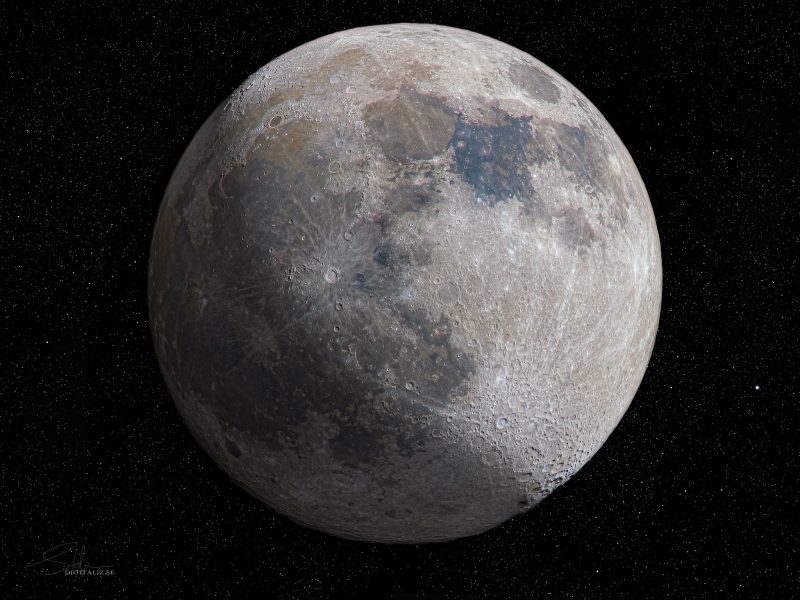
New Evidence About the Moon Makes More Creationist Sense

I found a new study of the moon fascinating. Here is a report on the study. When the Apollo mission brought back moon rocks in the 1970s, we measured them and found that their chemical composition was of the same stuff as rocks on earth. This led to scientists rushing to embrace some sort of giant impact theory to explain the existence of the moon. That is, they proposed that early in Earth's history a Mars-sized object (Theia) struck earth, melting the upper layers and sending some of the "splash" of molten rock into orbit, which coalesced into the moon.

That never caused too much trouble for an Old Earth Creationist (OEC) view of things. Most OEC (such as Reasons to Believe) think that the "heavens and the earth", including the moon, were created in verse one, but were not made, appointed to their roles and set in position (stable orbit) or visible from the surface, until the fourth "day" of Genesis chapter one. Still, I was always a bit uncomfortable with the idea that the moon was carved out of the earth and was almost "birthed" by it from a giant impact. That is the kind of thing you would think that the text would at least allude to.

It was also hard to reconcile with the text saying that the early surface of earth was covered with water, a statement which science has confirmed. Even if the underlying crust was molten due to increased internal heat, a blast like that should have vaporized oceans. Shouldn't the text of early Genesis at least hint at such an event when describing these things?

Add to it the fact that our moon is very unusual among planets. It is much closer in size to its host planet than any other moon. It stabilizes earth's orbit and produced regular and substantial tides. Perhaps it does things for us that are necessary to sustain advanced life.

Well, the study I mentioned changes the picture considerably. It turns out only the outer layer of the moon has a chemical composition like earth- indicating it came from the same place. The inner part of the moon has a different composition, indicating a different origin. The article of course stuck to the party line about the "giant impact theory" being the cause. But the fact that the moon is really composed of an earth-like "crust" over a mantle and core of a different sort of world raises other possibilities.

What if there never was a giant impact of "Theia" and earth? What if instead there was a period of intense asteroid bombardment of early earth and the larger strikes each blasted a much smaller amount of fragments into earth orbit? Perhaps early earth had a bit of a "ring" of debris. Then Theia came along and was "made" into the moon by scooping up these fragments and adding them to its mass in a series of smaller but still potent impacts. If Theia had started in a somewhat different orbit from earth that would have changed as the debris moving in earth orbit transferred its momentum to the growing moon. So this "no giant impact" hypothesis explains the same facts, including less water on the moon than expected, and fits better with the text of Genesis chapter one.

******************

Get the book.


Please "like" and "share".