Sunday, September 26, 2021

Chordates Also Show Complexity From the Start

I recently wrote a post about comb jellies and how, contrary to evolutionary expectations, the initial members of the group had more advanced neurology than later members of the group. It was like they started with even more complexity than they needed for their niche (without apparent precursors) and then various members of the group lost differing amounts of complexity over time. It's obvious to anyone who thinks about it objectively (which unfortunately is not very many I've found) that this is completely contrary to macro-evolutionary expectations but perfectly compatible with a creationist view.

What I most often get out of naturalists on this one is that the evidence must be misleading and incomplete. OK, but then what you are doing there is taking macro-evolution on faith. That is, even if the evidence says otherwise, you assume that the evidence is incomplete and misleading and that your beliefs contrary to the evidence are correct. That's fine, but don't claim the mantle of "science" for your beliefs then. 

Note that I am not saying "there is no evolution". I think scripture teaches that the earth and the seas have the power to bring forth various living things- but not without God's help in both sea and land. In such a scenario, one cannot appeal to the considerable evidence that nature has taken a single species and over vast amounts of time diversified it into a family of closely-related genera to explain the extra-ordinary times in earth's history when new phyla and classes appear seemingly out of nowhere with tremendous amounts of initial complexity. The former does not explain the latter, it doesn't look like the latter, and the most reasonable conclusion is that some other mechanism of formation was involved.

The best point my naturalist associates made in my prior attempt to show this was that I had only the example of comb jellies, a relatively obscure phylum. Why would a creator God start them off with maximum complexity but go from simplest to complex with other denizens of the deep? Thus, this data point could be considered a fluke, and not an example by which we could judge the origin of life in the seas. It was a fair point. 

Too bad for them, the point is invalid. It wasn't just comb jellies that started off with more complexity than needed for the niche occupied by the phylum. The same thing happens with chordates, a group which includes us vertebrates. It turns out that the simpler one (Pikaia), long presumed to be the ancestor of an array of more complicated chordates, does not appear earlier than those more complicated types. Dr. Fuzale Rana of Reasons to Believe explains the evidence here, but he links to the original research so there is no good reason to doubt his facts.

The short version of his article is that they assumed the simpler chordate came first (520 million years ago) then later more complex ones arose. Then they found the more complex ones in an earlier formation. So something similar happened with chordates and comb jellies- they start with more complexity than they need and some groups then mostly lose it! Bear in mind that, as Rana explains here, just twenty years ago evolutionary scientists thought that chordates evolved from invertebrate phyla that also appeared in the Cambrian. Now they not only have to explain away why the chordates show up too early and too distinct for that to be the case, but that it isn't even the case that the simplest versions of the type are first!

Dr. Hugh Ross, an associate of Rana at Reasons to Believe, points out that the genetic tree evidence is conflicting- if you insist on imposing naturalistic evolution. It isn't conflicting at all if you take the evidence at face value- phyla show up independently and rapidly and all in the same era without reasonable evolutionary precursors. 

I found one paragraph in the Ross link, from June of this year, particularly enlightening and satisfying. We are coming to basically the same conclusions based on the same evidence. This is mostly Ross citing two papers from secular researchers, which I provide the cite for below the paragraph..... 

"5 Furthermore, the fossil record shows that “there are no indications that the evolutionary activity at the family level was driving the origination of higher-level taxa.”6 In fact, “the diversification of phyla occurs before that of classes, classes before that of orders, and orders before that of families”7 

6. https://onlinelibrary.wiley.com/doi/epdf/10.1111/j.1558-5646.1987.tb02459.x

7.Erwin, Valentine, and Sepkoski, Jr., “A Comparative Study.”

That sure sounds like these papers are saying that what I noticed about comb jellies isn't a fluke at all- it is typical of the origin of all living phyla. Life started in distinct forms and the phyla became classes and super-orders and so forth. Only when you get far down the taxonomic classification ladder do things start to go the other way and species began diversifying into genera. What is lacking is any evidence that new phyla, or even classes, can arise via that same process.

**********************

My book about early Genesis is far more about Theology than science, and that's good. I've come to see we won't really get the science right, big picture anyway, without getting the theology right. If you have found anything I say about the evidence from science in the least remarkable, know that it is nothing at all compared to the profound truths shown about the work of Christ in early Genesis as described in this book.


    You Tube Channel 


Sunday, September 19, 2021

Genes Can Respond to Coded Information in Signals

 https://phys.org/news/2021-08-genes-coded-signalsor-filter.html

I assumed that when God shaped new living creatures He operated on the quantum level, sending information from the eternal realm into the temporal realm. Things would look like "a series of extremely unlikely natural events". And I still think that. But wow, messages can be sent directing the genome via EM radiation, and how different genomes interpret the signal varies. So the same EM signal could tell some organisms to do one thing and another something else. Lots of ways the Creator could have done His handiwork. 

Thursday, September 2, 2021

Comb Jelly De-Evolution

Nature keeps messing up. That is, naturalists come up with all of these wonderfully consistent (with their premises) hypotheses, but then when they actually conduct the research it turns out that nature has done the opposite. 

Take their recent research into comb jellies. Naturalists have assumed that living forms started out simple, and over time grew more complex. To be sure there have been cases where an organism lost complexity and returned to a simpler form, but this has to be the exception under naturalism, not the rule. After all, you can't go from amoebas to man by losing complexity. The early organisms have to start with less complexity and then develop more and more complexity over time. Yet ancient comb jellies had complex nervous systems. Modern ones have lost complexity, even though their lifestyles haven't changed much since the beginning. 

How did they get complex nervous systems, more complex than they needed- only to lose various degrees of it over time? Here is another quote from the article.... 

To better understand the evolution of this group, the team performed phylogenetic analysis which suggests the condensed nervous system is actually the ancestral condition and that only modern ctenophores have lost this complex nervous system and instead favored a more diffuse nerve net.......

The researchers conclude that Cambrian ctenophores had more complex nervous systems compared to those observed today. Living species of comb jellies have a diffuse nervous system similar to the structure of chicken wire, but very thin and transparent. Cambrian ctenophores' nervous systems were condensed with specific nerve tracks that basically ran along the length of the body and then as a ring around the mouth. This complex system is only seen in one living species, the Euplokamis, which is regarded as potentially being an early branching ctenophore living today. However, while Euplokamis has this elongated nerve structure that runs the length of the body, it does not have the ring around the mouth, so it too is simpler compared to Cambrian ctenophores.

So they can survive with a simple nervous system, or a complicated one, or something in between. How did nature produce the early models with the full suite of nervous system features when much simpler arrangements have actually proved to be perfectly satisfactory for what they do? The simple systems may even be a little better, based on the fact that most groups of comb jellies have that set up. 

Evolution isn't supposed to work like that. Animals are not supposed to start out with a bunch of complex systems that they don't need. Loss of complexity may come later, in certain exceptional cases when environment or lifestyle changes...for example if some group of them adopts a new life-style or environment where the original system is no longer used. Think blind cave fish who lost their sight. But this isn't that. Their life-style hasn't changed much. 

They are not supposed to start complex (where did that come from if simple was good enough?) and devolve to simple when the lifestyle is basically the same. It makes no sense- under naturalist premises anyway. It does make sense in the Christ-centered model for early Genesis. Nature does bring forth living creatures, but not without God putting her in position to do so. 

(Additional relevant note: This study says that ctenophores have such a different nervous system, including using different genes to form it, that it appears that nervous systems had more than one origin. 

Recent data show that neural systems of ctenophores are vastly different from those of other animals and use different sets of cellular and genetic mechanisms. Thus, neural systems appear to have at least two independent origins regardless of whether ctenophores or sponges are the earliest branching extant animal lineage.

So don't look for a common ancestor of regular jellyfish and comb jellies to solve this mystery. It wasn't the case that something with a regular nervous branched off and became comb jellies that didn't need one anymore. This group had its own independently derived nervous system, that most of the group got rid of after going to all the trouble to "develop". )

******

My book about early Genesis is far more about Theology than science, and that's good. I've come to see we won't really get the science right, big picture anyway, without getting the theology right. 


    You Tube Channel 


Sunday, August 29, 2021

Fast Tetrapod Evolution Looks like Slow Tetrapod Creationism

 
I saw a report on yet another study which challenges a naturalistic view of origins, though the government-funded researchers cited in the article didn't put it that way of course. 

Advocates of naturalism: I am going to start this post off with points you may have heard before but if you keep reading you will see I am going to take it somewhere you very, very likely have not considered before, because it is based on results discovered only in the last two or three years. I am asking that you not leap to conclusions based on the first paragraphs and dismiss it as something you've already considered. Try to hear what I am really getting at. It is amazing and frustrating at how hard it has been to get people, regardless of their philosophy, to do this. Everyone scans until they can put what they read into some box they have pat answers for. If you do this here, you are not getting it. Despite my writing this warning, I predict that most naturalists who read this post will still do it. That's how powerful and debilitating mental Pidgeon-holing is.

Consider these quotes:

"The researchers also found that most of the close relatives to tetrapods had exceptionally slow rates of anatomical evolution, suggesting the fish relatives to tetrapods were quite well adapted to their aquatic lifestyle.

"On the other hand, we discovered the evolutionary lineages leading to the first tetrapods broke away from that stable pattern, acquiring several of the major new adaptive traits at incredibly fast rates that were sustained for approximately 30 million years," said Simões."

So far interesting, but only a little out of line with the Punctuated Equilibrium view of evolution which popped up some decades back. That is, there are large periods of stasis which are broken by periods of very rapid change. Most don't dare call these events "macro-evolution" but that's what they are talking about. Notice two things. One is that the rate of change wasn't just fast but "incredibly fast". The fast changes continued for thirty million years, but that doesn't mean that the change from fish to tetrapod took that long. It is just how long the rapid changes went on for. With just a little more looking they may find what they found with the incredibly fast changes in the Cambrian Explosion.

That is, that while the period of rapid change in the Cambrian went on for 30 million years, the initial burst occurred in less than 410,000 years. This is obviously too fast for new basic body plans (phyla) to evolve by any mechanisms that we see operating today. Even if by some rare yet natural chance a hopeful monster could be born with a successful new body plan, it doesn't explain why over a dozen new body plans did so at the same time. How come all the miracles happened in such close succession? 

Under naturalist premises the original idea was that evolution was constantly occurring as creatures were shaped by their environment. Once they learned more they realized that while this does go on, it is limited in extent and forms are stable most of the time. There is a slow background sort of evolution as the earth fiddles within a type. It is only on rare occasions that this stability is punctured (thus the name Punctuated Equilibrium) by rapid change. In an impressive feat of cognitive dissonance, some naturalists will hold this view while at the same time denying there is any difference between micro-evolution and macro-evolution, claiming one is just the cumulative effect of the other. 

Under the original idea a new niche opening up is what precipitated the evolution of new forms. This idea has been kept, without noticing how it is incongruous with newer discoveries in the field and Punctuated Equilibrium. Essentially, once in a great while by chance there will be an exceptionally unlikely event. Nature pops up with something very different from what was before it only a short while back. If there is an unexploited niche for it to fill then it prospers greatly. All by chance, no intent or Designer required. It seems like a reasonable idea on the surface. Yet people haven't stopped to realize that the party line on unexploited niches doesn't fit with the party line on P.E. and what we have actually found in the Cambrian. 

Hear this: even if they were right about this process, under P.E. an empty niche does not guarantee that a creature will show up to fill that empty niche. It still requires the exceptionally unlikely event. Under the old view, where change was steady state and continuous, and forms near infinitely malleable without islands of stability, it made sense that empty niches would be inevitably filled. Under P.E. it doesn't make sense and it surely doesn't make sense that the new forms would all arise in a batch as they did during the Cambrian. They'd have us believe that all of the exceptionally unlikely events occurred together, yet it was still chance and not intent which brought them about!

To many creationists, in particular Old Earth ones, P.E. is simply accommodating evolutionary theory to describe what things would look like if supernatural creation were also true. That is, the steady state sort of background evolution is the earth bringing forth living creatures and the establishment of new kinds is God helping nature fulfill His command to nature. My particular view of Genesis chapter one is a Christ-centered one: We live in a universe fit for beings like us- we can't do God's will without God's help and neither can nature. This is why, not only is there a difference in micro-evolution and macro-evolution, but macro-evolution actually happens much faster than all but the smallest variations via micro-evolution. When God gets involved, big changes can happen fast. When nature is left on her own, it takes a long time to make very little progress. It isn't that evolution is untrue, it is just a part of what is being done in creation. 

And then, the pattern seems to be repeating itself with the tetrapods. But something else happened with tetrapods, and it is a repeat of the pattern seen of ocean life in the Ordovician. See these quotes from the article:
The researchers also found that the fast rates of anatomical evolution in the tetrapod lineage were not associated with fast rates of species diversification. In fact, there were very few species around, so few they had a very low probability of being preserved in the fossil record.

This finding helps to answer an ongoing debate in evolution of whether new major animal groups originated under fast rates of anatomical change and species diversification (the classical hypothesis). Or, if there were high rates of anatomical evolution first, with increased rates of species diversification occurring only several million years later (a new hypothesis).

"What we've been finding in the last couple of years is that you have lots of anatomical changes during the construction of new animal body plans at short periods of geological time, generating high rates of anatomical evolution, like we're seeing with the first tetrapods. But in terms of number of species, they remained constrained and at really low numbers for a really long time, and only after tens of millions of years do they actually diversify and become higher in number of species. There's definitely a decoupling there," said Simões.

It sounds like they are saying that macro-evolution happens fast, but micro-evolution happens slowly in nature. That isn't what they expected under naturalist premises, that's why the idea is  "a new hypothesis". Note I did not put the parenthesis in the quote above, they were from the article.

Now here is the new observation I want to make: if this happened under naturalistic processes there would be no reason for diversification of a new type of creature into a new environment full of new niches to be delayed.
It is like the new form of tetrapod was immediately well-adapted to be a generalist in its new niches. Under P.E. it is unlikely enough that nature even produces a new form, but when it does so, it is supposed to be a stroke of luck, not bit-by-bit shaping. So there is no reason for such a new form to be well-adapted to its new environment. Therefore there is no reason why speciation should be delayed. Indeed, there should be more impetus for it than there was in the original stable environment from which it came. Instead we see big changes continuing for millions of years and only many millions of years later species diversification occurring. 

This is nonsensical under naturalistic premises. One extremely rare event (high rate of anatomical 'evolution') is followed by others, but the normal sort of background evolution doesn't even start filling in with a diversity of species until much later. 

Someone suggested to me that the new tetrapods had a new environment so they didn't need to speciate to fill niches within that new environment. This doesn't take into account how things really work. If the first tetrapods fill a niche at the mouth of a river, after the first thousand years those down river are not competing with the population still at the mouth, but the original niche at the mouth of that river is very much filled, and if they try to go down river the adjacent population is already there, so the same evolutionary pressure that supposedly always work to drive speciation should be at work after a matter of centuries if not sooner. The great delay in this sort of background evolution while macro-evolution continues to churn out one miracle after another of creatures perfectly suited for their increasingly inland freshwater environment flies in the face of what we would expect to happen if natural forces are totally responsible for the change. The new form was supremely suited for the role of generalist in the new environment so that there was no pressure for speciation for a very long time. This only makes sense under the old slow environment-shaping evolution or special creation. Sudden appearance of a new form is incongruent with sublime suitability in the new environment, unless there is more than blind chance at work.

If natural explanations were correct then we should see new species branching off each new form very quickly. We don't. It is as if each new form was already well-adapted to its environment. That isn't the footprint of blind nature at work friends. It looks exactly like what things should look like if there was a Designer who knew what He was doing. 


******

My book about early Genesis is far more about Theology than science, and that's good. I've come to see we won't really get the science right, big picture anyway, without getting the theology right. 


    You Tube Channel 


Sunday, August 1, 2021

Have They Been Getting Evolution Wrong This Whole Time?

 Apparently so. Oh I don't mean in the vaguest sense of defining it as "change over time". If that is all it means then of course evolution is true. In this world change is inevitable. If all it means is "a change in gene frequencies over time" then again, of course that is correct. It is merely a subset of the first definition. Heck, even if God personally genetically engineered the founding members of every new family of life that ever lived on this earth, both of those definitions would still be true because neither specifies the power behind the change. 

Merriam Webster defines it as "descent with modification from preexisting species." There is no doubt that happens too, but even this definition dodges the real question of whether this process is responsible for all the variation in life in earth's history. For example, domestic dogs are an example of descent with modification from pre-existing species, wolves, but this does not mean that squid and eagles shared a common ancestor by natural descent. To assume otherwise based on the wolf-to-dog evidence alone is a gross example of the scientific error of "unsound extrapolation of data." This is the mistake of assuming that a given amount of known change can tell us about change that we don't really have the data for.  

One might even argue (as I would) that domestic dogs are an example of intelligent design (through selective breeding) as well as an example of Webster's definition of evolution. I would add further that if an Intelligent Designer fashioned every family of life on earth by modifying life forms from pre-existing families then this process would also meet Webster's definition of "evolution". So then one can legitimately "believe in evolution" and still "believe in creationism". One can believe that "evolution happened" without believing that evolution did it all. 

My point in the two-above paragraphs is that it is extremely difficult to extract a definition of "evolution" from naturalists which even acknowledges that a question might exist as to whether this process relies on natural means alone and can be extrapolated so that it can be rightfully considered the sole explanation for all variation in living things. The naturalistic premises are not stated in the definition, nor the absolute totality of the dogma as expressed in practice, but so many naturalists go on to act as if they were stated. 

Too many of them refuse to even see my point on this. They just won't allow themselves to see it. I don't like to start out by questioning motives, but when real engagement is avoided it leads to the question of motives. So by now I view this as a tedious attempt to rig the definitions in order to obscure the rational bases for reconsidering their premises. Is that science or dogma? Is it the business of science to obscure questions or answer them? It is particularly irritating coming from people who present themselves as the arbiters of honest inquiry. 

Those of you in the science community who may be tempted to feel offended by this, if there is substance to what I say then being offended doesn't do anything to solve the problem. I think many people outside the science community see things as I do even if they can't articulate why they find engaging with you so frustrating. You may be tempted to write off their reaction as a result of ignorance and hard-headedness on their part. Don't do that. You will never get better doing that. Even if your unwillingness or inability to consider the argument from truly neutral premises is even 1% of the problem, that's the 1% that it is your responsibility to do something about. Add to it that enhancing your ability to see things from other premises can only make you better at science and life. 

An honest definition of evolution as used by most in science today would be something like "The theory that natural processes alone produced changes in genes over time, and this combined with natural selection formed new varieties of organisms so that all living things are related to all other living things via natural descent". Webster gets closest to this with their alternative definition of evolution "the scientific theory explaining the appearance of new species and varieties through the action of various biological mechanisms (such as natural selection, genetic mutation or drift, and hybridization)". 

This definition is more forthright than those commonly used because it comes closest to specifying natural means and gives examples of those means. To use a science phrase, "it is more testable" than the definitions that naturalists often try to foist on me when I attempt to engage them on the issues I have described above. Even this definition from Webster doesn't address the totality aspect of the theory which naturalists attempt to impose. That is to say, the belief that this represents the only means by which new forms have appeared and it is powerful enough to have produced all of the change we have found in the time it is proposed to have done so.

I apologize for having taken so long to get to the evidence which prompted the title to this article. I am a mere messenger and in order to make the message clear I had to spend a great deal of time dispensing with the fog generated by those whose interests are not met by such clarification. But the bottom line to me is that even if every living thing on earth descended from other living things via natural descent with no assist from an Intelligent Designer (aside from us humans as described with dogs and wolves above) considerable evidence suggests that they still don't have the mechanisms by which this occurred correct. 

That's right, despite all the supremely confident assurances that they are right and implications that you are a dolt for failing to "trust the science" on these questions, some recent research has turned up some surprising mechanisms for change in organisms that have nothing to do with the traditional factors. 

This recent study shows how asexual organisms can adapt to their environment even in the absence of genetic information. It comes on the heels of earlier studies like one I wrote about here showing that fly behavior is altered without changes to the genome but rather through epigenetic changes that are not heritable the way genetic changes are. 

Another study I wrote about suggests that Lamarck was right even though his ideas have been rejected for over 100 years. Jean Baptiste Lamarck was the first to outline a coherent theory of evolution, though not the one accepted today. He didn't know about genes. He thought there was some material force in the universe, like electromagnetism, which drove life to increasing complexity. He called this a "complexifying force". But his second major thesis is the one he was most known for: that animals can prompt biological changes in themselves by the use or disuse of a function. There was, he proposed. an additional "adaptive force." In his mind this change would then be hereditary.

Well, it turns out squid edit their own RNA. Their DNA can say one thing, but the messenger RNA can be altered, outside the cell nucleus, to make different proteins. I don't think there is any evidence such changes would be heritable, but it does speak to Lamarck's second thesis within the life of an animal. As far as his first thesis goes, what if the "complexifying force" isn't a force at all? Whatever its called, his ideas were rejected long ago, but these studies all suggest some neo-Lamarckism is in order.

I haven't even seen any serious attempt to examine if these findings challenge the existing ideas about evolution, but it seems almost intuitively obvious that they do. Right off hand, I wonder how the cumbersome process described in traditional evolutionary theory can even get off the ground? If living things can adapt to their environment without waiting for chance to produce a gene that works better in that environment, then traditional evolutionary mechanisms seem an inferior redundancy. That one squid with a mutation which helps him survive better in a given environment is outcompeted by myriads of his kind who functionally adapt in a similar way based on epigenetic changes that respond directly to the environment and not chance. How then do even beneficial mutations become established in such cases? There is built-in variability in living things which occurs completely outside the process described in the textbooks. 

Look, maybe there will be a sensible way they can fold these findings into what they already know and improve the odds that nature did it all. Maybe they will just sweep these questions under the ever-more-lumpy rug. I don't know. I just know that the smug air of certainty that they have got most of this figured out is unjustified based on findings from their own community. And that their failure to engage in a reasonable manner is going to have consequences. The confidence-gap that people have in the voice of the scientific community is beginning to waiver, despite a ramp-up effort by the establishment media to herd everyone into line. And that gap is going to grow because its based on real underlying and unaddressed issues in the community. 

This is where I could go off on another long riff about what it means as a Christian who is a scientist to put your vocation under the Lordship of Christ. But I won't do that. There are others better positioned than me to do that, and they ought to be the ones to do it. But surely humility, a desire to serve, and considering others before yourself along with honesty are big factors in that endeavor. 

*****


My book about early Genesis is far more about Theology than science, and that's good. I've come to see we won't really get the science right, big picture anyway, without getting the theology right. 


    You Tube Channel 

Thursday, July 22, 2021

The Great Leap Forward in Toolmaking When Adamics Appeared

 Thanks to Alexander Young for putting me onto this graphic. There was a great leap forward when what I believe was a distinct population which later became us appeared on the scene. Click on image for larger view.


Wednesday, June 30, 2021

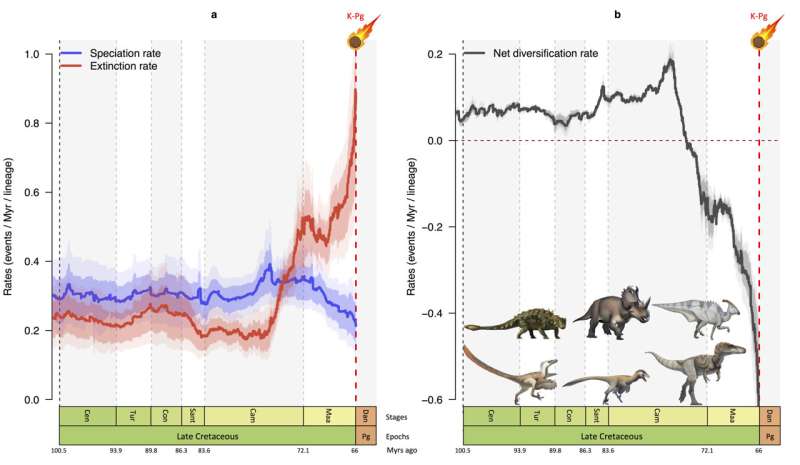
Was Nature Done With Dinosaurs Before the Asteroid?


A new study shows that dinosaurs were in serious decline before the asteroid which is credited with wiping them out hit. Here we see the drop in new species appearing verses the number of existing species going extinct. They were losing diversity even before the strike. 

In my view, creation and evolution have a complex interconnection which is not well explored in today's "debate" over the issue. Naturalism, the belief that nature is all that there is, is the big loser in all this, not creationism or, strictly speaking, evolution. 

For example, I've noticed before that nature acts in patterns which are better explained by the direction of a Purpose and an Intelligence rather than natural processes. This goes well beyond the most known example, the Cambrian Explosion. For example, the pattern of diversification shown in the Ordovician defies the expectations of naturalism as well. Indeed, "Burst after near stasis" seems to be a recurring theme of nature, and "Outlier Events" (compared to what would be expected if change was driven by random processes) are the norm. And contrary to the party line, there is only a weak correlation between these radiation events and mass extinctions. 

But that is on the side of new forms being produced. What about on the other side of the equation? That too doesn't fit the naturalist view of things. It turns out that not only do categories of organisms diversify in "bursts" with no apparent natural impetus, but they also stop bursting seemingly without natural explanation. 

The latest example is the broad and highly successful group "dinosaurs". Non-avian ones to be exact. According to the graphs above, it looks like they essentially "quit evolving" after true birds got here. One can argue that mammals were squeezing them out, that new types of plants arose that they were not so able to digest or what have you, but these bromides merely put off the question. Mammals kept evolving, plants kept evolving, why didn't dinosaurs? 

This is a pattern I've noticed before. It is almost as if once "Nature" is done playing with a type of organism, she moves on and that one mostly stops evolving. The change is then focused on the successor group.  I first observed this with relation to vertebrae in reptiles and mammals. Despite the vast diversity of reptiles, they seemed unable to develop more than one type of vertebrae in all the eons of time they have existed. Mammals meanwhile have five different types. Why can't reptiles evolve different kind of vertebrae when they changed so many other things?  It is as if "nature" was done playing with reptiles and had mostly moved on to something else. This makes no sense with naturalistic premises, but that's what nature looks like. 

I'm not the only one who has noticed this. I reported on a study which examined the same pattern which shows up throughout the 543 million years of animal life on earth. An ancestor form will have very little diversity. Then when the modern form appears, it bursts forth in tremendous diversity and swamps the ancestor form which often vanishes. So, the study concluded, a disproportionate amount of all the diversity which ever existed is found in presently living forms.  

If you think birds are from dinos, that surely describes what happened there. And birds didn't even take the niches held by the dinosaurs that went extinct. They went extinct even though they were mostly not competing with their own possible "successor form". And if the the study I started with is right, they were on their way out before the asteroid. It wasn't a strike that somehow selectively killed non-avian dinos while sparing birds. It was just the final blow to a group that was already failing to adapt- even though they had adapted quite well for over a hundred million years back when "nature" was letting them change with the times. 

Scientists have started asking the question "Is Evolution More Intelligent than we Thought?" The answer to this question is firstly that it is, in a way, a stupid question. "Evolution" can't be intelligent. But God can be intelligent. If what they are trying to say is that nature is behaving in ways that seem to be the product of an intelligence and wondering if therefore there is some kind of intelligence behind nature, then that isn't a stupid question. Rather it is an important question based on profound scientific observations. And the answer to it goes beyond what science can verify (IOW something science, a study of nature alone, must be "stupid" about). Our Creator God is that intelligence behind nature. 

*****

My book about early Genesis is far more about Theology than science, and that's good. I've come to see we won't really get the science right, big picture anyway, without getting the theology right. 


    You Tube Channel