Sunday, November 21, 2021

Chimp Genes Function Differently, Even if the DNA is the same


The headline declares "New Technique Underlies Genes in Human Evolution".

Strange how perspectives differ. They assume all of the differences, no matter how many they find, are due to "evolution".  I think the article highlights how different humans are from chimps, even if the genes seem identical. The article said they found "thousands" of genes that operate or regulate differently in human brains than in chimp brains. Well, we have maybe 30,000 protein-producing genes total. If "thousands" of them were found to operate differently (even if the underlying gene is identical) then the differences in humans and chimps functionally must be much greater than the 1.5% figure so often cited.

To use an analogy, it is almost like the gene has the job of building a carburetor. Same gene, if put in a push-mower builds one type of carb and the same gene if put in a Corvette builds another. How it expresses is coming from somewhere else. So it doesn't even matter if the genes are "98.5% identical". The gene somehow just says "build a carburetor", what that carburetor looks like depends on other things.  

Ergo, that the parts are the same does not at all demand natural evolution from a common ancestor any more than Briggs and Stratton and a 3.6 liter automobile engine must have even the same designer!
They have put jellyfish genes in mice and developed glowing mice. It isn't because they are closely related, but because the 'language' works. If I insert a word, "lavender" in one story from another in a place where color is a factor, it can still work even if the two stories were not in the same series or about the same subjects. That's because they were written in an intelligently, if haphazardly, designed code called "English". 

The more we learn, the less important similarities in chimpanzee vs human DNA seems to get. 


*****
The book is mostly not about evolution vs. creation, indeed part of it explains how most of the conflict is a false on. It is about something way more important than that- how early Genesis points to the work and person of Christ!

Sunday, November 14, 2021

Gobekli Tepe is Much Younger than 12,000 Years


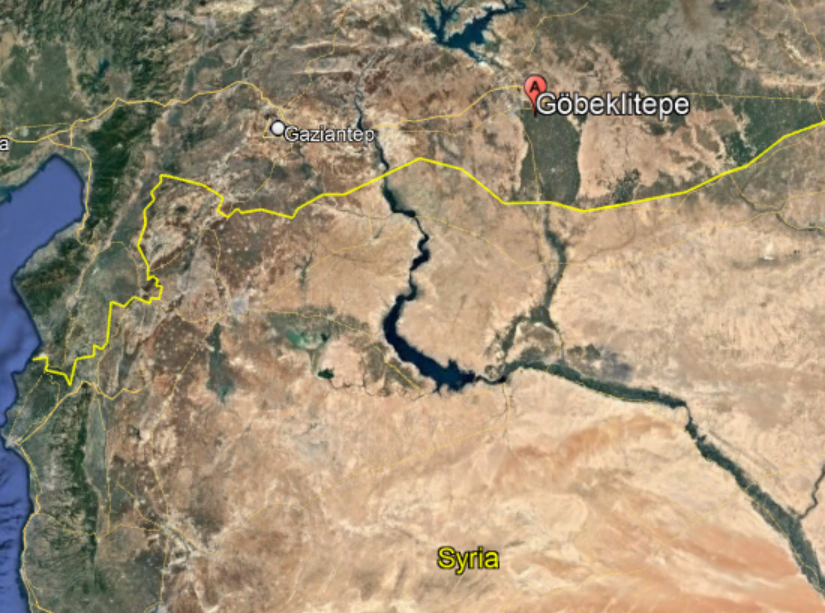
Many are familiar with the fantastic site of Gobekli Tepe in south-central Turkey. It is very near one area where I speculated the original garden of Eden was located. There is little doubt it is near to where true agriculture and animal domestication originated. It appears to have been a religious center where a series of large enclosed but roofless temples were constructed, used, and then deliberately buried over and over for a long period of time. 

The researcher who first popularized the site, a man named Schmidt, claimed that the site dated from the tenth millennium B.C., that is up to 12,000 years old. That date always bothered me a bit for reasons I will describe later. People like to think they have found "the oldest site of its kind" rather than say, the "the fifth oldest site of its kind". Researchers are humans and humans tend to look at the evidence in ways that are best for them. It turns out that the "tenth millennium B.C." date has been contested for years. We just don't know about the research because science media is so terrible and sensationalistic. 

A researcher named Dimitrios S. Dendrinos wrote a paper in 2016 claiming Gobekli Tepe was a much younger site, and was ignored. But the evidence kept coming in. He wrote a paper in 2021 making the case that Gobekli Tepe was a sixth millennium B.C. site. His logic is strong 

It is hard to date stone structures. So they got the date from dating things in the earth that was used to fill the structures when they were buried, and also some plaster that covered one of the pillars. The problem with that is that the dirt used to fill and cover could be much older than the structure itself. You can't use the oldest dirt you find in a fill to date the fill, the best you can do is find the youngest. In addition. the type of plaster they dated at the site is extremely prone to contamination. It is is buried from dirt that contained ashes from a campfire 12, 000 years ago, both the dirt and the plaster will show an C-14 date of 12,000 years even if the structure that was buried was much younger than that. 

Dendrinos dates Gobekli Tepe to the mid-sixth millennium B.C. In other words, around 5500 B.C. He does this by comparing the complexity of the structures and certain symbols found at the site to surrounding sites that are more firmly dated. It really makes sense that they would not start out with the most lavish and gigantic form at the beginning. 

Now onto why I found this of such interest. The focus of each enclosure was two immense T-shaped pillars. One of them was given anthropomorphic carvings, the other had carvings representing many animals. I had suggested in my book on Early Genesis that there is a connection between the two pillars which are central to each enclosure at this site and the "two trees" that were at the center of the garden of Eden. The ceremonies at Gobekli Tepe would then represent an attempt to "re-do" the garden with a more favorable result, choosing the Tree of Life (the God figure) over the tree of the Knowledge of Good and Evil. As each attempt failed, they would bury it, construct a new one, and try it again for their generation. Please don't be confused because I am writing as if there were other people around besides Adam and Eve. I believe that scripture teaches this, and this video gives some of the reasons why. 

What had been nagging at me was the extremely ancient age ascribed to the original structures. Perhaps you have heard reports saying that this site was constructed around 10,000 B.C., or twelve thousand years ago. Others tried to pin it down a bit more and say 11,300 years ago or about 9,300 B.C. 

These dates are very early if what we see at Gobekli Tepe is indeed a response to Adam's fall. I consider the dates for Adam in the Masoretic text (4004 B.C.) to be too young. The numbers in the Septuagint (about 5,500 B.C.) may be correct, but it is also possible that these are only theoretical minimum dates for reasons I describe in this video. I suggested in my book that Adam could have lived as early as 10,587 B.C., but this near the extreme end of the possible range and I was really thinking a date sometime between this date and the Septuagint date of 5,500 B.C. would be more probable. Low and behold, along comes this paper pushing the date for Gobekli Tepe to quite near the Septuagint date for Adam. 


    You Tube Channel 

Monday, October 25, 2021

Modern Marine Ecosystem in Place By Time Trilobite Fossils Appear

 This study made the case that the evolutionary rate of trilobites during the Cambrian wasn't all that extraordinary. Most naturalists look at that and say "See! The Cambrian Explosion wasn't all that explosive after all!" But if they do that they miss the fine print that makes their problem worse, not better. 

"We conclude that the Cambrian explosion was over by the time the typical Cambrian fossil record commences and reject an unfossilized Precambrian history for trilobites, solving a problem that had long troubled biologists since Darwin."

So they "solved a problem" about the Cambrian explosion by......saying the real explosion happened BEFORE the Cambrian trilobite fossils show up. Yet they also reject the idea that there was an unfossilized Precambrian history for trilobites. IOW, the explosion was over by the start of the typical fossil record, and there were none before that (in the Vendian).

"Our data therefore provide robust, quantitative evidence that by the time the typical Cambrian fossil record begins (∼521 Ma), the Cambrian explosion had already largely concluded. This suggests that a modern-style marine biosphere had rapidly emerged during the latest Ediacaran and earliest Cambrian (∼20 million years), followed by broad-scale evolutionary stasis throughout the remainder of the Cambrian."

I was glad they used the term "Cambrian explosion", as many science-deniers, of the naturalistic persuasion, have denied there was a true Cambrian explosion. Indeed the purpose of this study was to show that the Cambrian did not have excessively rapid rates of evolution- after the typical fossils of the period show up. But in so doing they are making what occurred before even more explosive!

They emphasize that trilobites did not have a pre-Cambrian history. Indeed one section of their report is "A Cambrian Origin for Trilobites". So somewhere between 541 million (edit, Wiki says 538.8 mya)  to 521 million years ago is when all of this change took place. By only looking at trilobites they are very much narrowing the scope of their problem because so many other forms show up too, including a host of trilobite-like creatures in addition to many other phyla. The oldest trace fossils of what can be described as euarthropods (a group which includes trilobites) are 537 million years old (last section). In other words, they show up at basically the same time everything else did (the Cambrian started 541 MYA). Indeed it apparently took only 410,000 years, a shockingly brief figure, for the Ediacaran biota to be replaced by Cambrian biota. This is made even more shocking compared to the very minimal evolutionary progress of the Ediacaran fauna. If evolution is universal, why didn't the Edicarans do much of it? The Cambrian biota showed much more diversification in their first eight million years (and likely much less) than their predecessors did in 80-100 million years. 

Saying that evolutionary rates were not much out of the norm for the Cambrian once typical (trilobite) fossils show up only solves the problem for the history of fossilization. It doesn't solve the problem of where this modern marine ecosystem came from, because it seems to be in place from the start, without reasonable ancestor forms. It would be like saying a billion dollars appeared in my bank account from nowhere but this is not unusual at all because after the billion dollars appeared my bank account behaved normally, changing with normal deposits and withdrawals. 

PS- there is an issue that defies naturalistic evolutionary expectations within the Cambrian, even if the overall rate isn't much out of the ordinary. The way things appear is strange. There are very few species per order (or sometimes "superfamily" depending on how they rate it). It is like things happened in the reverse of the description of evolution where a species over time becomes a group of closely related species called a genus. Then over more time one or more of those species gets so different than the rest that it becomes its own new genus. This in effect forms a new family that often contains many genera. Eventually that family may be so different from the original species, or other of its descendants, that it becomes a superfamily, or even a new order. But this isn't what we see in the Cambrian. New Orders show up without a lot of speciation. The leaps between form are bigger, even if there are fewer steps (species) between them. Saying that "speciation didn't occur at a fast rate during the bulk of the Cambrian" doesn't deal with this issue at all.

This study did not address how the evolution "started from the top" and went down rather than the standard bottom-up diversification we hear about. There isn't a lot of speciation going on, yet new types at higher taxonomic levels appear. Indeed simpler and more complex appear at the same time, defying naturalistic paradigms. But this isn't the only time that's happened in earth's history. It happened with tetrapods, it happened with comb-jellies, and it happened in the Ordovician. 


    You Tube Channel 

Wednesday, October 13, 2021

Two Atheist Scientists Convert to Christianity

 And they were saying some of the same things I have been saying. The one says that "Believing is seeing" to describe they way that people pick a view and then accumulate evidence to support it. The way I have been putting it is "All evidence is a mirror. It says as much about the viewer as the thing studied". We look at the same facts and draw different conclusions and that's why. The difference is not the evidence, its us!

The second fellow said that he studied the mind, and that naturalism can't explain the mind, nor can it explain physics. I've said the same thing myself in my book, and further speculated that as more and more evidence about biology is uncovered the failure of naturalism as an explanation will become more clear in that field as well. 

Read it all here. https://medium.com/top-down-or-bottom-up/two-former-atheist-scientists-explain-how-science-changed-their-minds-cc4535fcadd6

Monday, October 11, 2021

Plants Were Late Bloomers (Plant Evolution)

 11And God said, “Let the earth sprout vegetation, plantse yielding seed, and fruit trees bearing fruit in which is their seed, each according to its kind, on the earth.” And it was so. 12The earth brought forth vegetation, plants yielding seed according to their own kinds, and trees bearing fruit in which is their seed, each according to its kind."


These two verses in Genesis get the order right as far as the introduction of plants goes. The term "vegetation" is more general and includes things that sprout. I noticed that in scripture the adjective "green" is sometimes put in front of this word, making me wonder if it would not also include some things that we don't strictly regard as vegetation, such as lichens. The seed-bearing plants who bear fruit come last. This checks out with the order we see in nature. 

Plants seem to be late-comers to the earth. The seas were full of living things before the land was full of what we would call plants. Superficially, this would be a serious problem for a concordist view of Genesis chapter one. 

This isn't a problem for the Christ-centered model of early Genesis. Creation is supposed to be slow and awkward and even incapable of doing God's will without God's help. In other words, it is a suitable creation for beings like us! A close look at the text shows that while the filling of the seas and lands with animal life was a job God commanded the lands and seas themselves to do, He participated. They had to have help. In the case of plants, the situation is different. All God did was provide the dry land (itself pointing to the Resurrection) on the third day. He commanded the land to bring forth vegetation and the land did so without any record of God's further intervention. 

Creation wants to do His will, but it does so haltingly and imperfectly. It messes up a lot. Like us. This is why God can give the command to the land to bring forth plants first, but it takes much longer for the earth to pull it off compared to, for example, the seas where God provided more help. It all makes sense, but not under the view of creation that so many churches are teaching. 

I noticed that according to this report, the rise of plants took a while, and there was a modest "burst" followed by a much larger burst recently. That larger burst seems to have been driven by the variety of insects that served as pollinators. In other words, the plants didn't have a big burst until the animals were there as a driver. This is in contrast to the seas, where the biggest burst comes early (Cambrian Explosion) and others follow. This is a pattern that the Christ-centered model, but no other I have seen, would predict. 


    You Tube Channel 


Sunday, September 26, 2021

Traits are Linked. "Re-Thinking the Fundamentals of Evolution"

 Their headline, not mine. A study of a wide-spread African fish group has turned a quarter-century of evolutionary assumption upside down. Cichlids have a very complex set of double-jaws. Well, I will let the article tell it...

Researchers have long thought that the two sets of jaws are evolutionarily decoupled and can evolve independently of one another, pushing the boundaries of morphological evolution. However, Conith and Albertson demonstrated that such decoupling does not appear to be the case for cichlids, challenging a quarter-century-old assumption. "What we've found is not just that the evolution of the two sets of jaws is linked, but that they're linked across multiple levels, from genetic to evolutionary," says Albertson.

Traditional thinking is that genetically linked traits led to features that were constrained in terms of evolution. You could not tinker with the one without messing up the other, making accumulated changes much harder. You had to have a hail-mary that changed everything at once in a way that somehow still worked. 

any models of evolution theorize both that organisms are constructed from repeated units—digits on your hand or teeth in your mouth—and that these individual units evolve independently from one another. "It is this 'modularity' of organisms that is thought to facilitate the evolutionary process," Albertson notes.

Linked systems are usually thought to lack evolutionary potential. "They just cannot evolve in as many dimensions," Conith says. This is referred to as an evolutionary constraint, and it plays an important role in shaping biodiversity. Constraints determine what body structures are possible.

The article then does what such pieces typically do- take a discovery which ought to challenge naturalist premises and instead use it to claim support for them. All discoveries that naturalists were wrong about evolution automatically get re-interpreted to "this is how evolution works". When a quarter-century fundamental assumption is overturned, they don't even blink. Linked or unlinked, nature saw to all the changes unaided. It's a naturalism-of-the-gaps at work. 

"The constraint is actually facilitating cichlid evolution, rather than impeding it," says Conith.

Of course it is, because whatever happened, evolution did it.

"This tells us that we need to rethink the fundamentals of evolutionary mechanisms," says Albertson. "Perhaps constraints play a wider role in the evolutionary success of species around the world."

That sounds like however the constraints got imposed, it helped promote adaptation. Sort of like how God's commandments are not cages, but guard-rails. The so-called "constraints" imposed by the creator give us freedom, they don't remove it. 

********

My book about early Genesis is far more about Theology than science, and that's good. I've come to see we won't really get the science right, big picture anyway, without getting the theology right.  


                                                                        You Tube Channel 

Why Didn't the Ediacaran Biota Fill More Niches?

 The Ediacaran Biota seems to have been the first multi-cellular organisms on earth, living during the Vendian Period. No one is sure what they were. They died out once the Cambrian Explosion resulted in a large number of new forms of animal life appearing in the ancient seas. 

Most scientists acknowledge that the Ediacaran biota were not related to the later Cambrian forms. One role they play in the debate on creation is to show that hard shells are not required for fossilization- undermining the excuse that a lack of hard shells prior to the Cambrian explains the absence of reasonable evolutionary precursors to the explosion of forms in the Cambrian. Even without shells, if conditions are right, fossilization occurs. This makes it more likely that the reason that fossils of evolutionary precursors to the Cambrian forms are missing is that they did not exist. 

Of the many things that I find amazing about the Ediacaran forms is their lack of evolution. They expanded into a world where every macro niche was unfilled, yet over the course of 80-100 million years they apparently filled very few of them. This paper analyzed Vendian life-forms for where they lived in the ocean, their level of motility, and feeding strategy. This resulted in a matrix of 216 potential niches. As the paper notes:

The Ediacaran fauna utilized at most 12 modes of life, with just two practised by skeletal organisms.

They didn't evolve much. The Goldblum character from Jurassic Park's classic statement "life finds a way" wasn't true of Vendian Period forms. They didn't find a way. They left most niches wide-open for 80 to 100 million years. In contrast, the explosion of forms in the Cambrian quickly diversified as shown by their statement:

A total of 30 modes of life are recorded in the Early and Middle Cambrian, 19 of which were utilized by skeletal organisms. The other 11 are documented from soft-bodied animals preserved in the Chengjiang and Burgess Shale Konservat-Lagerstätten. The number of modes of life utilized by skeletal organisms increased by more than 50 per cent during the Ordovician radiation to a Late Ordovician total of 30....

The Ordovician radiation is another problem for naturalists. Life did not unfold they way their theories would have it. It isn't that species diversified into closely related ones, which over time became a new genus, then some from that became a new family, and then eventually some of that became a new order and so forth. Instead, the new phyla came first, then the new classes, and then the new orders. Only after an extended period of time did the process they call evolution begin to happen- with new species splitting and eventually forming a new genus and so forth. 

The early and middle Cambrian together lasted only 20 million years. Forty million years or so later the Ordovician came along. All of that together is less time than the Ediacaran forms had in the Vendian. Those forms basically didn't evolve. There was one burst in the Avalon where new forms show up. But they don't do a lot of subsequent changing. If evolution is fundamental to life, why didn't these things do it?

I don't have any hard answers here, only speculations. In the Christ-centered model Creation participates in its being filled to varying degrees by the "day" and type of living thing. With plants, it looks most like theistic evolution, with God simply commanding the land to bring forth "vegetation" and the land doing so without further direct intervention from God. God is giving the commands as if creation itself has some creative power. Later, God commands the seas to bring forth living creatures, but subsequent to that He intervenes on the job. One of the biggest theology points of the model is that the universe was made to be fit for beings like us- it can't do God's will without God's help either. 

So if I am speculating, and that is all this is at this point, perhaps the Ediacaran forms were an attempt of the earth to fill the waters with living creatures on its own. The result was inadequate and unsuitable. This deficit was cured by God's participation. This mirrors how our attempts to do good on our own fall flat, and are made fruitful only by operating in what He has done - the Atonement being the central example. 


**********************

My book about early Genesis is far more about Theology than science, and that's good. I've come to see we won't really get the science right, big picture anyway, without getting the theology right. If you have found anything I say about the evidence from science in the least remarkable, know that it is nothing at all compared to the profound truths shown about the work of Christ in early Genesis as described in this book.


    You Tube Channel